AI call recording software is becoming standard infrastructure inside many sales organizations. Platforms can now record meetings, summarize conversations, identify objections, track competitor mentions, and feed CRM systems automatically.
The pitch is compelling. Better coaching. Faster onboarding. More forecast visibility. Stronger documentation.
And to be fair, many of those benefits are real.
But most companies are approaching AI call recording the wrong way. They focus heavily on the software itself while barely thinking about governance, operating models, or leadership discipline.
That is where problems begin.
The real challenge is not whether the technology works. The real challenge is whether the organization knows how to use it responsibly and intelligently.
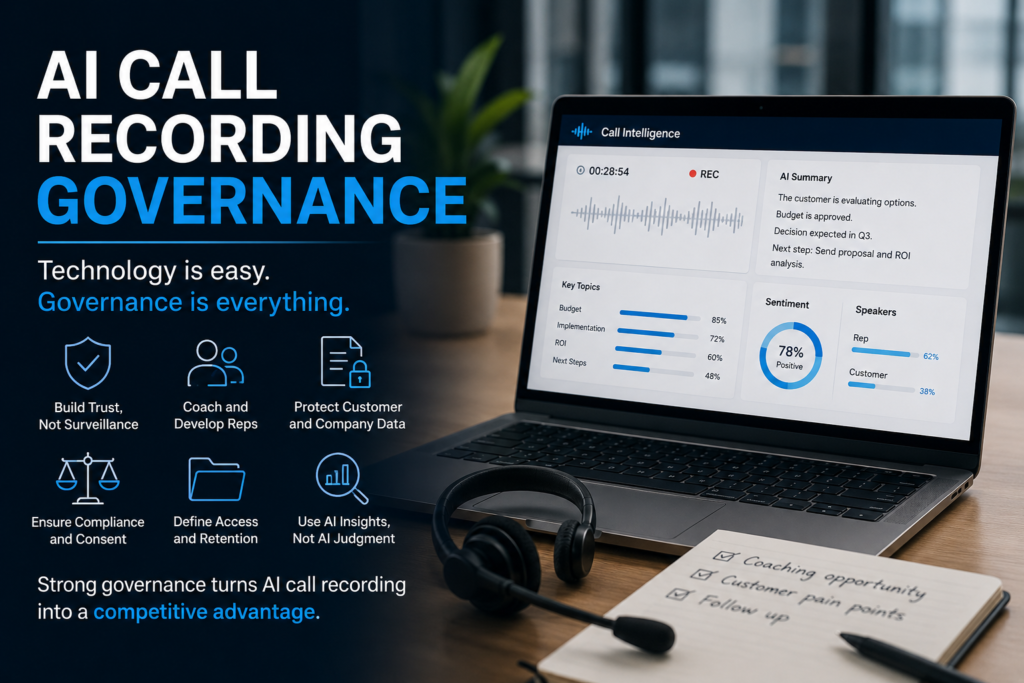
Governance Matters More Than the Software
Most vendors sell AI call recording as a productivity tool. They showcase dashboards, summaries, sentiment analysis, and coaching insights. But technology alone does not create operational maturity.
In fact, poorly governed systems often create confusion instead of clarity.
Many leaders quietly start treating AI-generated summaries as objective truth. That is dangerous. AI can identify patterns and structure, but it cannot fully understand context, emotional nuance, customer politics, hesitation, or strategic tension inside a conversation.
A transcript may technically capture the words correctly while completely missing the meaning behind them.
Strong sales leaders understand that AI outputs are artifacts, not judgment. The software can support decision-making, but it cannot replace leadership interpretation.
The Surveillance Problem
One of the fastest ways to damage adoption is to create a culture where reps feel constantly monitored.
If salespeople believe every word is permanently scored, analyzed, and evaluated, conversations become less natural. Reps may become overly cautious, less exploratory, and more performative during customer interactions.
That weakens the very thing sales organizations are supposedly trying to improve.
The strongest organizations position AI call recording as coaching infrastructure, not surveillance infrastructure. There is a massive cultural difference between those two approaches.
When trust exists, recordings become useful learning tools. Without trust, the platform becomes another layer of organizational anxiety.
Where Governance Actually Matters
Governance sounds abstract until companies run into real operational problems.
Recorded calls often contain sensitive information involving pricing, contracts, customer strategy, legal concerns, security conversations, and financial discussions. Without clear rules around retention, permissions, and access, organizations can unintentionally create major governance exposure.
Companies also struggle when they fail to define the purpose of the system upfront.
Is the goal coaching? Forecasting? Documentation? Compliance? Onboarding? Most organizations say “all of the above,” which usually leads to vague adoption and inconsistent usage.
Clear operating models matter more than feature lists.
Organizations should know:
- why calls are recorded
- who can access them
- how long recordings are retained
- how managers are expected to use the information
- when human review overrides AI-generated outputs
Those questions are operational questions, not technical ones.
Human Judgment Still Matters
There is a growing temptation in modern sales organizations to automate judgment itself.
That is a mistake.
AI can absolutely help surface patterns across hundreds of conversations. It can help managers review more calls, onboard new hires faster, and improve documentation quality.
But leadership still requires interpretation.
Good sales management involves reading between the lines, understanding organizational dynamics, recognizing customer hesitation, and applying contextual judgment. AI cannot fully replicate that.
The companies getting the most value from AI call recording are usually the companies that already have:
- strong management discipline
- healthy sales culture
- operational clarity
- mature processes
- trust inside the organization
The software amplifies strengths that already exist.
It also amplifies dysfunction.
Final Thoughts
The wrong question is:
“Should we buy AI call recording software?”
The better question is:
“What operating model do we need in order to use AI call recording responsibly and effectively?”
That distinction matters.
Because ultimately, this category is not really about recording calls. It is about operational maturity, leadership discipline, governance, and trust.
The technology itself is only part of the story.