AI call recording can be one of the most useful tools in a modern sales organization. It can help managers coach better, help reps improve faster, improve CRM notes, capture customer objections, and give leaders more visibility into what is actually happening in sales conversations.
But the tool creates a problem.
Once sales calls are recorded, transcribed, summarized, scored, stored, and shared, the organization is no longer just managing conversations. It is managing sensitive customer data, employee trust, consent practices, access rights, retention rules, and coaching culture.
That is why sales leaders need governance.
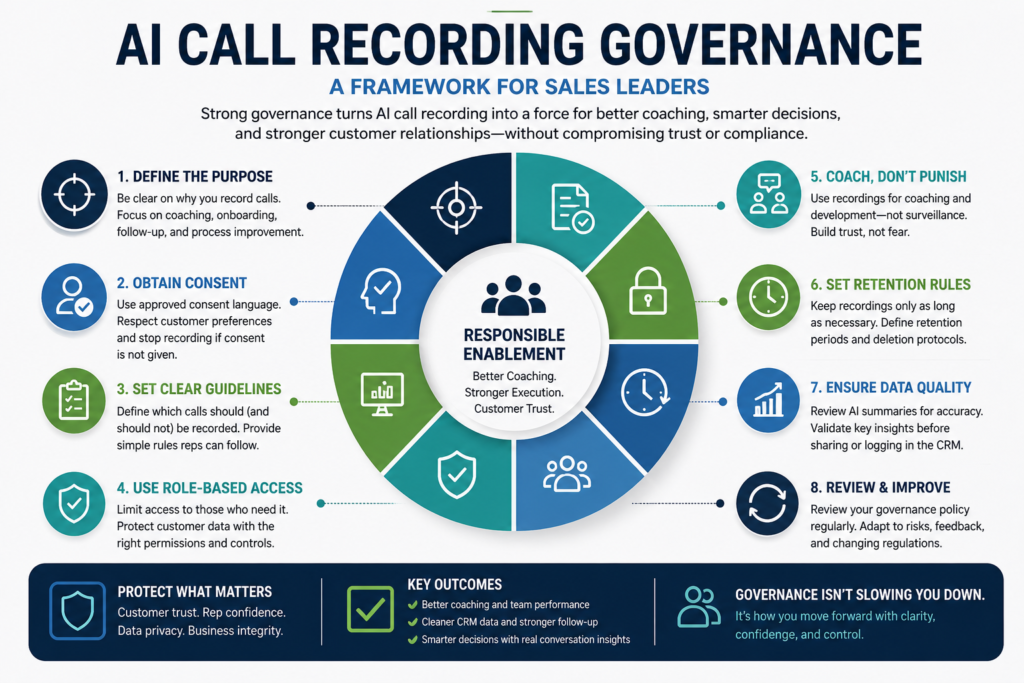
AI call recording governance is the operating framework that defines how recorded sales conversations should be captured, stored, accessed, reviewed, and used.
Without governance, AI call recording can quickly become messy. Reps may feel watched. Customers may become guarded. Managers may misuse summaries. Sensitive information may be stored too long. Leadership may start treating AI-generated insights as perfect truth.
With governance, the tool becomes much more valuable.
It becomes a system for better coaching, cleaner follow-up, stronger sales execution, and more responsible use of customer conversation data.
What Is AI Call Recording Governance?
AI call recording governance is the set of rules, policies, workflows, and expectations that guide how a sales team uses recorded calls and AI-generated call data.
A governance framework should answer questions like:
- When should calls be recorded?
- When should calls not be recorded?
- How should reps ask for consent?
- What happens if a customer says no?
- Who can access recordings and transcripts?
- How long should recordings be stored?
- Can managers use recordings in performance reviews?
- Can AI summaries be copied into the CRM?
- Who reviews the accuracy of AI-generated notes?
- What data should never be stored?
- How often should the policy be reviewed?
In plain English, governance tells the organization:
This is how we use AI call recording responsibly.
Why Sales Leaders Need a Governance Framework
Many companies roll out AI call recording like it is just another sales productivity feature.
That is a mistake.
AI call recording affects the daily behavior of reps, managers, customers, sales operations, legal teams, and executives.
A sales call may include pricing, procurement concerns, internal politics, competitive information, security requirements, legal issues, budget constraints, or personal details. Once that call is recorded and transcribed, the company has created a data asset — and a risk.
Governance matters because it protects four things:
- Customer trust
- Rep trust
- Data quality
- Organizational judgment
The goal is not to slow the business down. The goal is to make sure the business uses the tool with clarity.
1. Define the Purpose of AI Call Recording
The first governance question is simple:
Why are we recording calls?
Sales leaders need to define the purpose before the tool becomes part of daily operations.
Common purposes include:
- Sales coaching
- New rep onboarding
- CRM note support
- Customer follow-up
- Forecast inspection
- Deal risk review
- Product feedback
- Competitive intelligence
- Customer success handoffs
- Compliance documentation
The problem is when companies say the purpose is coaching but then quietly use recordings as a punishment tool.
That destroys trust.
If the purpose is coaching, say that clearly. If recordings may be used for compliance or performance review, say that too. Reps deserve to know how the data can be used.
A good purpose statement might look like this:
Our sales team uses AI call recording to improve coaching, strengthen customer follow-up, support CRM accuracy, and identify recurring customer needs. Recordings are intended to support better sales execution, not to create a surveillance culture.
That kind of statement gives the tool a clear identity.
2. Define Which Calls Should Be Recorded
Not every sales conversation needs to be recorded.
A governance framework should define when recording is standard, optional, or discouraged.
Calls that may make sense to record
- Discovery calls
- Product demos
- Qualification calls
- Customer onboarding calls
- Renewal conversations
- Implementation handoffs
- Training calls
- Customer success check-ins
These calls often contain useful information for coaching, follow-up, and account management.
Calls that may require caution
- Legal discussions
- Sensitive procurement negotiations
- HR-related customer conversations
- Security incident discussions
- Highly regulated customer conversations
- Executive escalations
- Calls where the customer declines recording
A simple policy is better than a vague one.
For example:
Record standard sales and customer-facing calls when consent is provided. Do not record legal discussions, sensitive escalations, or conversations where the customer objects.
The goal is to make the rule easy for reps to understand in real life.
3. Create Approved Consent Language
Consent is one of the most important parts of AI call recording governance.
Sales reps should not be forced to invent disclosure language on the spot. The company should provide approved language that is simple, respectful, and easy to use.
Example:
“Do you mind if I record this call so I can stay focused on the conversation and send accurate notes afterward?”
Another option:
“Is it okay if I record this meeting for note-taking purposes? I’ll use it to make sure I capture the details correctly.”
The language should be clear without sounding robotic.
Sales leaders should also define what happens if the customer says no.
The rep should know whether to:
- Turn off the recording
- Continue the meeting without recording
- Take manual notes
- Remove the AI assistant from the meeting
- Notify a manager if needed
A good governance framework removes uncertainty.
4. Separate Coaching From Performance Management
This may be the most important cultural rule.
AI call recording should not blur the line between coaching and formal performance management.
Coaching use
Coaching use means recordings are used to help reps improve. Examples include:
- Reviewing discovery questions
- Improving objection handling
- Practicing executive conversations
- Strengthening demo flow
- Coaching next-step discipline
- Studying successful calls
- Helping new reps ramp faster
Performance management use
Performance management use is different. It may involve:
- Formal performance reviews
- HR investigations
- Compliance reviews
- Disciplinary conversations
- Documentation of repeated behavior
- Escalated quality issues
These two use cases should not be treated the same.
A strong policy might say:
Call recordings are primarily used for coaching, onboarding, customer follow-up, and operational improvement. Any use of recordings for formal disciplinary or HR-related purposes requires additional review and approval.
This protects the coaching culture.
If every call can become a performance weapon, reps will stop trusting the system.
5. Create Manager Usage Rules
Managers are the most important users of AI call recording.
They can either make the tool valuable or make it toxic.
A governance framework should clearly define healthy and unhealthy manager behavior.
Healthy manager uses
Managers should use recordings to:
- Prepare better coaching sessions
- Identify team-wide skill gaps
- Highlight strong examples
- Help reps improve follow-up
- Review deal risks with context
- Support onboarding
- Improve messaging consistency
- Find recurring objections
Unhealthy manager uses
Managers should avoid:
- Randomly hunting for mistakes
- Reviewing calls without context
- Using AI summaries as final truth
- Publicly embarrassing reps with clips
- Overreacting to one bad call
- Comparing reps without considering account complexity
- Using talk ratios or sentiment scores as absolute judgments
AI-generated data should support management judgment. It should not replace it.
A good manager listens for context. A bad manager cherry-picks clips.
6. Use Role-Based Access Controls
Not everyone needs access to every recording.
Access should be based on role, purpose, and business need.
A simple access model may look like this:
Reps
Reps can access their own calls, summaries, transcripts, and action items.
Front-line managers
Managers can access calls for reps on their team.
Sales leadership
Sales leaders can access selected calls for coaching, forecasting, enablement, and strategic review.
Sales enablement
Enablement can access approved calls for training libraries and onboarding.
Product and marketing
Product and marketing may access approved clips, themes, or tagged insights, but not necessarily full call libraries.
HR and legal
HR and legal access should be limited to specific approved situations.
The mistake is giving broad access to everyone.
That creates risk and damages trust.
7. Set Retention Rules
Recorded calls should not be kept forever by default.
A retention policy defines how long recordings, transcripts, summaries, and AI-generated notes are stored.
Common retention options include:
- 90 days
- 180 days
- 365 days
- Longer for selected training calls or compliance needs
The right retention period depends on the company, industry, customer expectations, and legal requirements.
But the key is to have a rule.
The policy should answer:
- How long are recordings kept?
- Are transcripts kept for the same period?
- Are AI summaries stored separately?
- Who can delete recordings?
- Are certain calls exempt from deletion?
- What happens when a customer requests deletion?
- How is retention handled when a deal closes or is lost?
Keeping everything forever may feel safe, but it can create unnecessary risk.
Good governance balances usefulness with restraint.
8. Create a Call Tagging System
If every call is recorded but nothing is organized, the library becomes useless.
Sales leaders should create a simple taxonomy for tagging calls.
Useful tags may include:
- Discovery
- Demo
- Pricing
- Renewal
- Churn risk
- Competitor mention
- Budget objection
- Security concern
- Legal concern
- Procurement
- Executive sponsor
- Product gap
- Implementation risk
- Strong coaching example
- Training library candidate
The purpose of tagging is to turn recordings into a searchable knowledge system.
Instead of having thousands of calls, the organization can find useful moments.
For example:
- Best pricing objection examples
- Calls where a competitor was mentioned
- Calls with implementation concerns
- Calls that show strong discovery
- Calls that reveal product gaps
This is where AI call recording becomes operational intelligence.
9. Require Human Review of AI Summaries
AI-generated summaries are helpful, but they should not be trusted blindly.
A governance framework should require human review before summaries are used in high-impact workflows.
For example, reps should review summaries before:
- Sending follow-up emails
- Updating CRM opportunity notes
- Sharing recaps with customers
- Escalating deal risk
- Creating handoff notes for customer success
- Summarizing commitments made during the call
The rule should be simple:
AI can draft the summary. The human owns the accuracy.
This matters because AI can miss tone, nuance, hesitation, sarcasm, uncertainty, or relationship context.
A customer who says, “That might work if procurement is comfortable,” has not fully committed.
AI summaries can flatten that nuance.
10. Protect Sensitive Customer Information
Sales conversations often include sensitive customer information.
A governance policy should define what kind of information should not be stored, copied, or widely shared.
Examples may include:
- Passwords
- Private personal information
- Legal strategy
- Security vulnerabilities
- Confidential financial details
- Internal customer personnel issues
- Unapproved competitive information
- Highly sensitive procurement discussions
Reps should be trained to recognize when a conversation becomes sensitive.
Managers should know when to stop recording or restrict access.
Sales leaders should also understand how vendors store, process, and protect recorded call data.
Vendor risk matters because the conversation data does not live only in the sales team’s head anymore. It may live inside a third-party platform.
11. Train Reps Before Rollout
A common mistake is turning on AI call recording and assuming reps will figure it out.
They need training.
Training should cover:
- Why the company is using AI call recording
- How recordings will be used
- How recordings will not be used
- How to ask for consent
- What to do if a customer declines
- How to review summaries
- How to correct CRM notes
- How to use recordings for self-coaching
- What sensitive information to avoid storing
- Who to contact with concerns
The rollout should feel like a professional enablement program, not a surprise monitoring system.
The tone matters.
Sales leaders should present AI call recording as a way to help the team get better, not as a way to catch people doing something wrong.
12. Train Managers Separately
Managers need their own training because they control the culture of the tool.
Manager training should cover:
- How to coach from recordings
- How to avoid “gotcha” reviews
- How to use AI summaries responsibly
- How to discuss calls with reps
- How to identify team-wide patterns
- How to separate coaching from performance management
- How to select good training examples
- How to avoid over-reliance on AI scores
A manager who misuses call recordings can destroy trust quickly.
A manager who uses them well can accelerate learning across the entire team.
13. Review the Governance Policy Regularly
AI tools change quickly. Sales processes change. Legal requirements can change. Customer expectations can change.
Governance should not be set once and forgotten.
A practical review schedule:
- 30 days after rollout
- 90 days after rollout
- Every six months after that
During review, sales leaders should ask:
- Are reps comfortable with the tool?
- Are customers objecting to recording?
- Are managers using recordings appropriately?
- Are summaries accurate enough?
- Are CRM notes improving?
- Are recordings being retained too long?
- Are access controls working?
- Are there any sensitive data concerns?
- Are we getting real coaching value?
The goal is continuous improvement.
Example AI Call Recording Governance Policy
Here is a simple starting framework sales leaders can adapt.
Purpose
AI call recording is used to support coaching, onboarding, customer follow-up, CRM accuracy, and sales process improvement.
Consent
Reps must disclose recording and receive consent when required. If a customer declines, the recording must be stopped and the meeting may continue without recording.
Recording standards
Standard discovery, demo, renewal, onboarding, and customer success calls may be recorded. Sensitive legal, HR, security, or escalation conversations should not be recorded without approval.
Access
Reps may access their own calls. Managers may access their team’s calls. Broader access requires a defined business purpose.
Coaching
Recordings should primarily be used for coaching and development. Managers should review calls with context and avoid using isolated clips punitively.
Performance use
Use of recordings for formal performance management, HR, disciplinary, or investigative purposes requires additional approval.
Retention
Recordings and transcripts should be retained only for the approved retention period unless specifically preserved for training, legal, or compliance reasons.
AI summaries
AI summaries must be reviewed by a human before being sent externally, entered into CRM as official notes, or used for management decisions.
Sensitive information
Reps and managers should avoid storing, sharing, or widely distributing sensitive customer information captured in recordings.
Review
The policy should be reviewed regularly by sales leadership, sales operations, legal, and enablement.
Common Mistakes to Avoid
Mistake 1: No Written Policy
If the rules are not written down, they are not real.
A verbal understanding is not enough.
Mistake 2: Letting Every Manager Use the Tool Differently
Inconsistent manager behavior creates distrust.
The team needs common standards.
Mistake 3: Treating AI Scores as Truth
Talk ratios, sentiment scores, and AI-generated insights can be useful signals. They are not complete judgments.
Mistake 4: Ignoring Customer Comfort
Just because the software can record does not mean every customer will be comfortable.
Respect matters.
Mistake 5: Keeping Too Much Data
Retaining every recording forever can create clutter and risk.
Mistake 6: Using Recordings Only When Something Goes Wrong
If recordings are only reviewed after a problem, reps will associate the tool with punishment.
Use recordings for positive coaching too.
Mistake 7: Failing to Explain the Why
Reps are more likely to accept AI call recording when they understand the purpose, limits, and benefits.
The Bottom Line
AI call recording can help sales teams become sharper, faster, and more consistent.
But the tool needs rules.
Without governance, AI call recording can damage trust, create compliance issues, overwhelm managers with data, and turn coaching into surveillance.
With governance, it can improve coaching, strengthen follow-up, protect customer information, and help leaders understand what is really happening in the sales process.
The best sales organizations will not be the ones that record the most calls.
They will be the ones that use recorded conversations with the most judgment.
AI call recording governance is not bureaucracy.
It is how sales leaders make the technology useful, ethical, and sustainable.