For most revenue organizations, pipeline scoring is still stuck in a rep-centric mindset: activity counts, stage checklists, and optimistic forecasts that collapse late in the quarter.
At the CRO level, that approach breaks down.
What CROs actually need is not more data, but better signal—a way to understand which deals are real, which are fragile, and which are quietly distorting the forecast.
This is where custom deal scoring using Agentforce inside Salesforce becomes a powerful executive tool—when designed correctly.
Why Traditional Deal Scoring Fails CROs
Most deal scoring systems were built for:
Rep prioritization
Front-line coaching
Lead qualification
CROs, by contrast, are responsible for:
Forecast credibility
Capital allocation
Executive visibility
Board-level accuracy
The problem isn’t effort—it’s truth distortion. Deals linger too long, optimism compounds, and risk signals surface only after it’s too late.
Static scoring models can’t reason across:
Time
Behavior
Historical outcomes
Unstructured deal context
Agentforce can.
What “Agentforce Deal Scoring” Actually Means
Agentforce is not just a numeric scoring engine. It’s a reasoning layer that evaluates opportunities continuously by combining:
Structured CRM data
Activity patterns
Call and note summaries
Historical win/loss similarity
Behavioral signals from buyers and sellers
The output is not just a score—but an explanation.
AI call recording software is becoming standard infrastructure inside many sales organizations. Platforms can now record meetings, summarize conversations, identify objections, track competitor mentions, and feed CRM systems automatically.
The pitch is compelling. Better coaching. Faster onboarding. More forecast visibility. Stronger documentation.
And to be fair, many of those benefits are real.
But most companies are approaching AI call recording the wrong way. They focus heavily on the software itself while barely thinking about governance, operating models, or leadership discipline.
That is where problems begin.
The real challenge is not whether the technology works. The real challenge is whether the organization knows how to use it responsibly and intelligently.
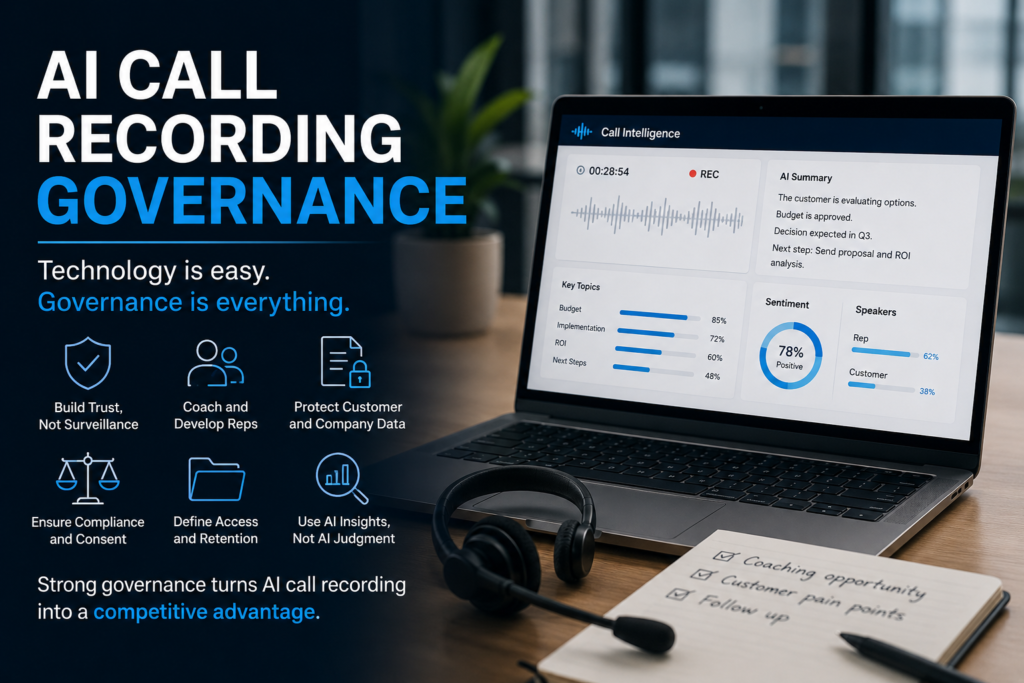
Governance Matters More Than the Software
Most vendors sell AI call recording as a productivity tool. They showcase dashboards, summaries, sentiment analysis, and coaching insights. But technology alone does not create operational maturity.
In fact, poorly governed systems often create confusion instead of clarity.
Many leaders quietly start treating AI-generated summaries as objective truth. That is dangerous. AI can identify patterns and structure, but it cannot fully understand context, emotional nuance, customer politics, hesitation, or strategic tension inside a conversation.
A transcript may technically capture the words correctly while completely missing the meaning behind them.
Strong sales leaders understand that AI outputs are artifacts, not judgment. The software can support decision-making, but it cannot replace leadership interpretation.
The Surveillance Problem
One of the fastest ways to damage adoption is to create a culture where reps feel constantly monitored.
If salespeople believe every word is permanently scored, analyzed, and evaluated, conversations become less natural. Reps may become overly cautious, less exploratory, and more performative during customer interactions.
That weakens the very thing sales organizations are supposedly trying to improve.
The strongest organizations position AI call recording as coaching infrastructure, not surveillance infrastructure. There is a massive cultural difference between those two approaches.
When trust exists, recordings become useful learning tools. Without trust, the platform becomes another layer of organizational anxiety.
Where Governance Actually Matters
Governance sounds abstract until companies run into real operational problems.
Recorded calls often contain sensitive information involving pricing, contracts, customer strategy, legal concerns, security conversations, and financial discussions. Without clear rules around retention, permissions, and access, organizations can unintentionally create major governance exposure.
Companies also struggle when they fail to define the purpose of the system upfront.
Is the goal coaching? Forecasting? Documentation? Compliance? Onboarding? Most organizations say “all of the above,” which usually leads to vague adoption and inconsistent usage.
Clear operating models matter more than feature lists.
Organizations should know:
why calls are recorded
who can access them
how long recordings are retained
how managers are expected to use the information
when human review overrides AI-generated outputs
Those questions are operational questions, not technical ones.
Human Judgment Still Matters
There is a growing temptation in modern sales organizations to automate judgment itself.
That is a mistake.
AI can absolutely help surface patterns across hundreds of conversations. It can help managers review more calls, onboard new hires faster, and improve documentation quality.
But leadership still requires interpretation.
Good sales management involves reading between the lines, understanding organizational dynamics, recognizing customer hesitation, and applying contextual judgment. AI cannot fully replicate that.
The companies getting the most value from AI call recording are usually the companies that already have:
strong management discipline
healthy sales culture
operational clarity
mature processes
trust inside the organization
The software amplifies strengths that already exist.
It also amplifies dysfunction.
Final Thoughts
The wrong question is: “Should we buy AI call recording software?”
The better question is: “What operating model do we need in order to use AI call recording responsibly and effectively?”
That distinction matters.
Because ultimately, this category is not really about recording calls. It is about operational maturity, leadership discipline, governance, and trust.
Sales forecasting is often treated like a math problem.
It is not.
Most forecast problems begin long before a number ever reaches a spreadsheet or CRM dashboard. Forecast accuracy is ultimately a systems problem involving sales behavior, stage discipline, data quality, management pressure, and operational visibility.
In many organizations, the issue is not a lack of reporting. It is an overload of disconnected metrics that fail to reflect actual buyer behavior.
A predictable revenue system requires more than quarterly optimism and pipeline reviews. It requires disciplined definitions, connected data, and a shared understanding of what real deal progression actually looks like.
Why Forecast Accuracy Breaks Down
Most forecast misses do not happen because finance teams cannot calculate revenue correctly.
They happen because the underlying sales data was flawed from the beginning.
Common causes include:
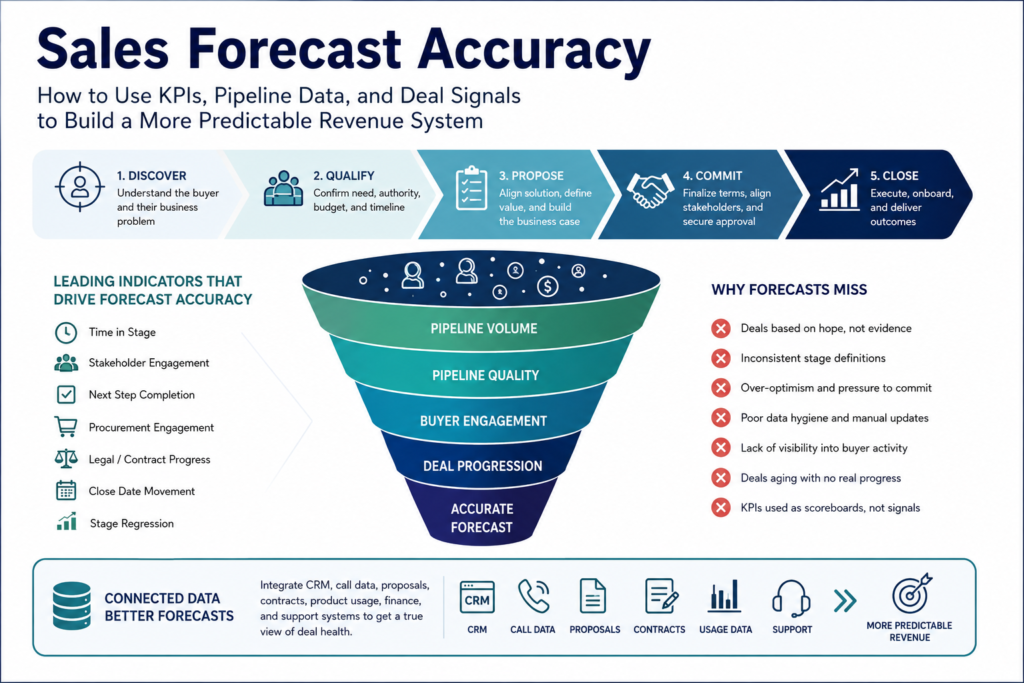
Reps forecasting based on hope instead of evidence
Undefined or inconsistent stage criteria
Pressure to inflate commit numbers
CRM hygiene problems
Lack of visibility into buyer-side activity
Deals remaining open long after momentum has died
Leadership rewarding optimism instead of accuracy
In many companies, the CRM becomes less of a source of truth and more of a political document.
The result is predictable:
Pipeline inflation
Missed forecasts
Resource misallocation
Hiring mistakes
Unrealistic board expectations
Operational chaos
Forecasting improves when organizations stop treating it as a spreadsheet exercise and start treating it as a revenue operating system.
KPIs Are Leading Indicators, Not Scoreboards
One of the biggest mistakes in sales leadership is using KPIs as historical scoreboards instead of operational indicators.
Revenue is a lagging indicator.
By the time revenue declines, the real problems likely began months earlier.
Strong revenue organizations monitor leading indicators that reveal whether pipeline quality and buyer engagement are improving or deteriorating before quarter-end pressure arrives.
Examples of valuable leading indicators include:
Time in stage
Multi-threading across stakeholders
Next-step completion rates
Proposal turnaround time
Procurement engagement
Legal review initiation
Meeting frequency
Opportunity aging
Close date movement
Stage regression frequency
These signals matter because they reflect buyer movement, not seller confidence.
A healthy forecasting culture focuses less on “What number are we calling?” and more on “What evidence supports the number?”
Forecasting Is a Behavior Problem, Not a Math Problem
Most forecasting failures are behavioral before they are analytical.
Sales teams are often incentivized to present confidence rather than accuracy.
That creates predictable distortions:
Sandbagging
Artificial pipeline inflation
End-of-quarter optimism
Deals sitting in commit without buyer movement
Managers overriding reality to protect expectations
Forecasting systems become unreliable when organizations reward enthusiasm over evidence.
For example, a rep may believe a deal is highly likely because the relationship feels strong. But if procurement has not engaged, legal has not reviewed terms, and no implementation planning has begun, the opportunity may still be immature.
The problem is not intent. The problem is confusing seller emotion with operational reality.
Predictable revenue systems reduce ambiguity by defining what progression actually means.
Why Deals Stall in Commit
Many organizations treat the commit stage as a confidence bucket.
That is dangerous.
A deal should not enter commit because a seller “feels good” about it. It should enter commit because objective signals indicate meaningful buyer-side progression.
When commit discipline weakens, several things happen:
Forecast volatility increases
Leadership loses confidence in CRM data
Pipeline reviews become emotional debates
Quarter-end surprises become normal
Common warning signs of unhealthy commit-stage deals include:
No scheduled next step
Repeated close date movement
Single-threaded relationships
No procurement engagement
Undefined implementation timelines
No legal activity
Low executive involvement
Large periods of inactivity
One of the most valuable exercises for revenue leaders is analyzing historical commit-stage slippage.
Patterns usually emerge quickly.
For example:
Deals over a certain age may rarely close
Single-threaded enterprise opportunities may consistently slip
Opportunities without procurement engagement may have low conversion rates
Certain industries may experience longer legal cycles
This is where forecasting evolves from opinion into operational intelligence.
When a Deal Is Real Enough to Forecast
Forecast inclusion should be evidence-based.
A deal is not forecastable simply because it exists in the CRM.
A healthier approach is defining objective qualification standards for forecast inclusion.
A forecastable opportunity often includes:
Confirmed Business Problem
The buyer has clearly articulated a real operational, financial, or strategic issue.
Identified Decision Process
The organization understands how purchasing decisions are made and who is involved.
Economic Buyer Access
Someone with budget authority or strategic influence is engaged.
Defined Timeline
There is a credible business reason for action within a specific timeframe.
Mutual Action Plan
Both sides understand the next steps required to move forward.
Procurement or Legal Engagement
Operational buying processes have started.
Implementation Awareness
The customer is thinking beyond evaluation and into deployment or adoption.
The key principle is simple:
Forecast confidence should increase when buyer-side evidence increases.
Avoiding KPI Myopia in High-Value Deals
Metrics are useful.
Overreliance on metrics can become dangerous.
Not every high-value opportunity behaves like a transactional sales motion.
Enterprise deals often involve:
Longer decision cycles
Complex procurement processes
Executive sponsorship
Budget realignment
Legal negotiation
Cross-functional approval
A dashboard may flag these opportunities as “stalled” even when strategic progress is occurring behind the scenes.
This is where experienced sales leadership matters.
Revenue systems should support judgment, not replace it.
KPI myopia occurs when organizations optimize for metric appearance instead of revenue quality.
Examples include:
Prioritizing activity volume over strategic conversations
Overemphasizing call counts
Penalizing legitimate deal-cycle complexity
Forcing unrealistic close dates for reporting optics
Treating every opportunity equally regardless of strategic value
Strong forecasting systems combine quantitative signals with operational context.
The Pipeline Signals Revenue Leaders Should Monitor
Forecasting improves dramatically when organizations focus on pipeline health signals instead of isolated revenue targets.
Important operational signals include:
Signal
Why It Matters
Opportunity aging
Older deals often have lower conversion probability
Stage regression
Deals moving backward indicate instability
Close date movement
Repeated pushes reduce forecast confidence
Stakeholder engagement
Multi-threaded deals are generally healthier
Procurement involvement
Indicates operational buying momentum
Legal activity
Often signals late-stage seriousness
Next-step completion
Reveals execution discipline
Forecast change history
Shows consistency and predictability
Pipeline source quality
Some channels produce healthier opportunities
Time-to-proposal
Operational efficiency impacts conversion
Over time, these signals create a more realistic view of revenue predictability than simple pipeline totals alone.
Why Connected Data Matters in Forecasting
Forecasting becomes difficult when critical operational data is fragmented across disconnected systems.
Many organizations have useful signals trapped inside:
CRM platforms
ERP systems
Contract systems
Proposal tools
Call recording platforms
Customer success platforms
Marketing automation systems
Finance systems
Support platforms
The challenge is not a lack of data.
The challenge is operational visibility.
For example:
CRM shows a deal is in commit
But call activity has declined
Legal has not engaged
Product usage is low
Procurement communication has stopped
No implementation resources have been discussed
Without connected data, leadership sees an incomplete picture.
This is where modern data engineering and RevOps infrastructure become critical.
Custom data pipelines can help organizations:
Consolidate pipeline signals
Improve forecasting visibility
Standardize KPI definitions
Track buyer progression
Identify forecast risk patterns
Build more accurate reporting systems
Reduce manual forecasting effort
Improve executive decision-making
Better forecasting is not simply about better dashboards.
It is about creating a cleaner operational system underneath the dashboard.
Final Thoughts
Sales forecasting will never be perfect.
But it can become dramatically more reliable when organizations stop treating forecasting as a quarterly ritual and start treating it as a connected operational discipline.
Predictable revenue systems are built through:
Clear stage definitions
Strong CRM hygiene
Behavioral accountability
Evidence-based forecasting
Connected operational data
KPI discipline
Leadership consistency
The best forecasting organizations are not necessarily the most optimistic.
AI call recording is becoming a standard part of the modern sales stack. Tools like Gong, Clari Copilot, Zoom AI Companion, Microsoft Teams, and other conversation intelligence platforms can record sales calls, create transcripts, summarize meetings, identify objections, and help managers coach reps more consistently.
That sounds simple.
Record the call. Summarize the conversation. Update the CRM. Improve coaching. Move faster.
But AI call recording is not just a productivity tool. It changes how sales teams communicate, how managers coach, how customer information is stored, and how organizations handle privacy, consent, and trust.
Used well, AI call recording can make a sales team smarter, more consistent, and more prepared. Used poorly, it can create surveillance anxiety, compliance risk, bad data, and a weaker sales culture.
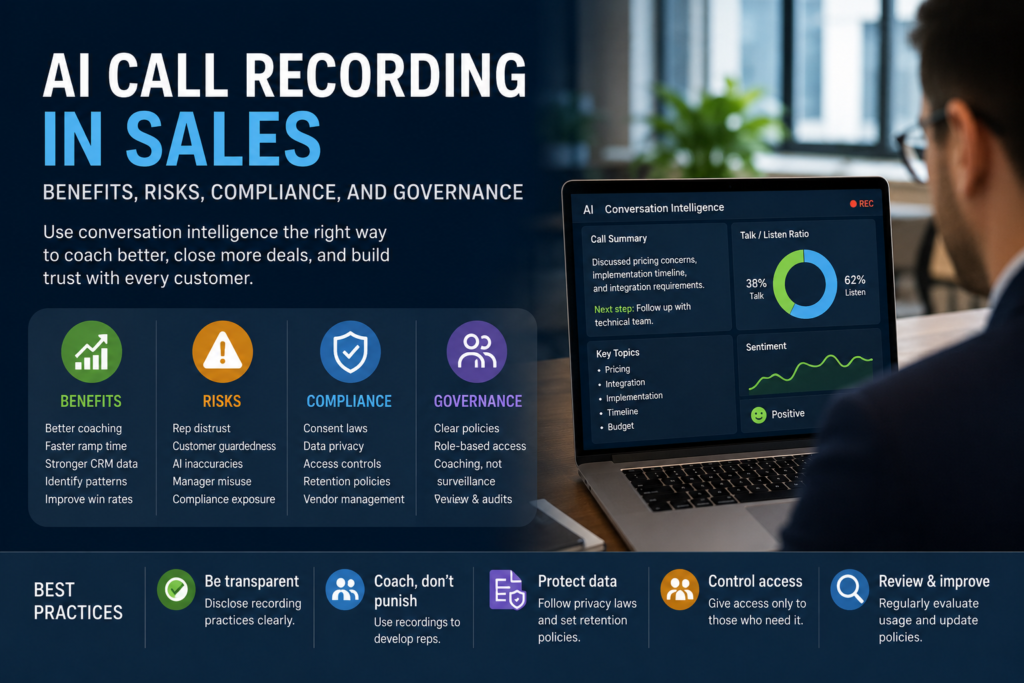
This guide explains the benefits, risks, compliance issues, and governance practices sales leaders should understand before rolling out AI call recording across a team.
What Is AI Call Recording?
AI call recording refers to software that records sales conversations and uses artificial intelligence to analyze them.
A typical AI call recording platform may provide:
Meeting recordings
Call transcripts
AI-generated summaries
Action items
CRM notes
Objection tracking
Competitor mentions
Talk-to-listen ratios
Sentiment indicators
Coaching recommendations
Deal risk signals
In plain English, AI call recording turns sales conversations into searchable data.
That is the opportunity.
Instead of relying only on a rep’s memory, handwritten notes, or a manager randomly joining calls, the organization gets a record of what was said, what was promised, what objections came up, and what needs to happen next.
But that same power creates responsibility. Recorded conversations often contain customer problems, pricing discussions, internal politics, personal details, negotiation strategy, and sensitive business information.
That is why AI call recording needs to be treated as both a sales enablement tool and a governance issue.
Why Sales Teams Use AI Call Recording
Sales teams use AI call recording because sales conversations contain valuable information that is easy to lose.
A discovery call may reveal the real business pain. A demo may expose confusion about the product. A pricing conversation may show hesitation from the buyer. A renewal call may surface risk months before a customer churns.
Without recording, much of that information disappears.
AI call recording helps sales teams capture and reuse that knowledge.
The Main Benefits of AI Call Recording
Better Sales Coaching
One of the biggest benefits is coaching.
Before AI call recording, managers often had limited visibility into actual sales conversations. They might join a few calls, review CRM notes, or rely on the rep’s version of what happened.
AI call recording gives managers more direct evidence.
They can review real calls, identify patterns, and coach based on actual behavior rather than vague impressions.
For example, a manager may discover that a rep:
Talks too much during discovery
Skips business impact questions
Fails to confirm next steps
Handles pricing objections too defensively
Does not ask enough follow-up questions
That kind of coaching can be specific and useful.
Instead of saying, “You need to improve discovery,” the manager can say, “At minute 14, the customer mentioned budget pressure. That was a chance to ask how the project is being funded.”
That is much better coaching.
Faster Ramp Time for New Reps
AI call recording can also help new sales reps ramp faster.
New reps can study real examples of:
Strong discovery calls
Effective demos
Pricing conversations
Objection handling
Competitive positioning
Executive-level conversations
Renewal risk discussions
This gives new hires a library of real sales situations instead of only training decks and role plays.
The best training is often watching how strong performers handle real conversations.
Better Follow-Up
AI-generated summaries can help reps write better follow-up emails and update CRM records more quickly.
After a call, AI can often produce:
Meeting recap
Key pain points
Customer goals
Action items
Decision criteria
Next steps
Open questions
This can save time and reduce sloppy follow-up.
But there is a catch: AI summaries should not be treated as final truth. They should be reviewed by the rep before being sent to a customer or entered into the CRM.
The AI can help. The human still owns the message.
Stronger CRM Hygiene
Sales organizations often struggle with CRM quality.
Reps forget details. Notes are inconsistent. Opportunities are updated late. Managers get incomplete information.
AI call recording can improve CRM hygiene by giving reps a cleaner starting point for updates.
A good AI summary can help capture:
Who attended
What was discussed
What the customer cares about
What objections came up
What next step was agreed to
What timeline was mentioned
That improves sales operations, forecasting, and account management.
Better Visibility Into Customer Patterns
At scale, AI call recording can help leaders identify patterns across many conversations.
For example:
Which objections come up most often?
Which competitors are mentioned most?
Where do demos lose momentum?
What product gaps are customers raising?
What language do buyers use to describe their pain?
What risks appear in renewal conversations?
This is where AI call recording becomes more than a coaching tool. It becomes a source of market intelligence.
Sales calls are one of the richest data sources inside a company. AI makes that data easier to search and analyze.
The Main Risks of AI Call Recording
AI call recording also creates real risks.
The biggest mistake leaders make is assuming the tool is automatically good because it produces more data.
More data is not the same thing as better judgment.
Reps May Feel Watched Instead of Coached
If AI call recording is rolled out poorly, reps may feel like they are under surveillance.
That creates fear.
Instead of thinking, “This will help me improve,” reps may think:
“Is my manager looking for mistakes?”
“Will one bad call be used against me?”
“Am I being scored by an algorithm?”
“Is this coaching or monitoring?”
Once reps feel watched, behavior changes. They may become less natural, less creative, and less willing to take risks in conversations.
That hurts performance.
A sales team needs accountability, but it also needs trust. AI call recording should support coaching, not create a culture of gotcha management.
Customers May Become More Guarded
Customers may also behave differently when they know a call is being recorded.
Some buyers will not care. Others will become more cautious.
They may share less about:
Internal politics
Budget constraints
Competitive evaluations
Implementation concerns
Decision-maker dynamics
Legal or procurement issues
That matters because the most useful sales information is often sensitive and nuanced.
A recorded call can sometimes become a more sanitized call.
Sales leaders need to understand that recording changes the environment. It is not neutral.
AI Summaries Can Be Wrong
AI summaries are useful, but they are not perfect.
They can miss nuance, misstate details, or over-simplify what happened.
For example, a customer saying:
“This could be interesting, but we have budget concerns.”
Might get summarized as:
“Customer is interested in moving forward.”
That is dangerous.
The difference between curiosity and commitment matters.
If reps, managers, or executives treat AI summaries as perfect, they can make bad decisions with confidence.
That may be the most dangerous kind of error.
Managers Can Misuse the Data
Even well-intentioned managers can misuse call recordings.
They may:
Review calls without context
Over-focus on isolated mistakes
Use AI scores as performance judgments
Compare reps unfairly
Turn coaching into criticism
Use recordings to confirm existing bias
A recorded call is evidence, but it is not the whole story.
A manager still needs judgment.
Too Much Data Can Create Noise
Recording every call can create an enormous library of information.
That sounds valuable, but without structure it becomes noise.
If the organization has no tagging system, no review process, no retention policy, and no clear ownership, the call library becomes a dumping ground.
The company has more data, but not more insight.
Compliance Issues Sales Teams Should Understand
AI call recording also raises compliance and privacy questions.
This is not legal advice, but sales leaders should know the basic risk areas and involve legal counsel before rolling out recording tools.
Consent Rules Matter
Recording laws can vary by location. Some places require one-party consent. Others require all-party consent.
That means a sales team operating across states, countries, or regions needs a clear policy for disclosure and consent.
A casual approach is risky.
A rep should not be inventing consent language on the fly. The company should provide approved language.
Example:
“Before we begin, is it okay if I record this call so I can capture accurate notes and follow up properly?”
If the customer says no, the rep should know exactly what to do.
Storage and Retention Matter
Recorded calls may contain sensitive business information.
That means companies need to decide:
Where recordings are stored
Who can access them
How long they are kept
When they are deleted
Whether transcripts follow the same retention rules
Whether recordings are connected to CRM records
Whether vendors can access the data
Keeping everything forever is usually not a strategy. It is a liability.
Access Controls Matter
Not everyone in the company should have access to every call.
Access should be role-based.
For example:
Reps can access their own calls
Managers can access their team’s calls
Sales leadership can access selected calls for coaching and review
Product or marketing may get access to approved snippets or tagged themes
HR/legal access should require a clear process
Without access controls, AI call recording can quickly feel invasive.
Customer Data Matters
Sales calls can include confidential customer information.
A customer may discuss:
Revenue
Budgets
Vendor problems
Internal decision-making
Security concerns
Legal issues
Strategic priorities
That information should be handled carefully.
Sales teams need to remember that a call recording is not just “sales data.” It may also be customer confidential information.
Governance: The Framework Every Sales Team Needs
The best sales teams do not just buy AI call recording software. They build a governance model around it.
Governance does not need to be complicated. It needs to be clear.
1. Define the Purpose
Start with the question:
Why are we recording calls?
Possible answers include:
Coaching
Onboarding
CRM accuracy
Forecast support
Customer handoffs
Product feedback
Compliance documentation
Market intelligence
The purpose matters because it shapes the rules.
If the stated purpose is coaching, do not quietly use recordings as a punitive performance tool. That destroys trust.
2. Create a Recording Policy
The company should define when calls should and should not be recorded.
For example:
Record:
Discovery calls
Demos
Implementation handoffs
Renewal discussions
Customer training calls
Do not record, or require special approval for:
Legal discussions
Sensitive negotiations
Internal escalations
Customer calls where the customer declines
Highly regulated conversations
The policy should be simple enough for reps to follow in real life.
3. Standardize Consent Language
Give reps approved consent language.
Do not make every rep improvise.
Good consent language should be:
Clear
Respectful
Short
Easy to say
Easy for the customer to decline
Example:
“Do you mind if I record this so I can stay focused on the conversation and send accurate notes afterward?”
That feels better than a cold legal disclaimer.
4. Separate Coaching From Performance Management
This is one of the most important rules.
Coaching use and performance use are not the same.
Coaching use means helping reps improve skills.
Performance use means using recordings for evaluation, discipline, compliance, or HR-related decisions.
A healthy policy should explain the difference.
For example:
Call recordings are primarily used for coaching, onboarding, and customer follow-up. Any use of recordings for formal performance review, investigation, or disciplinary action requires manager and HR approval.
That kind of clarity reduces fear.
5. Define Manager Rules
Managers need rules too.
They should know what good use looks like and what misuse looks like.
Healthy manager uses:
Reviewing calls with the rep
Identifying coaching themes
Sharing strong examples
Helping reps prepare for follow-up
Spotting deal risk
Improving team training
Unhealthy manager uses:
Randomly hunting for mistakes
Reviewing calls without context
Using AI summaries as final truth
Comparing reps without considering deal complexity
Turning every call into a performance critique
AI call recording should make managers better coaches, not better surveillance officers.
6. Set Retention Rules
Decide how long recordings and transcripts should be kept.
Common options might include:
90 days
180 days
365 days
Longer for selected training calls or regulated needs
The right answer depends on the business, legal requirements, customer expectations, and risk tolerance.
But there should be an answer.
No retention policy usually means the company keeps too much for too long.
7. Build a Tagging System
A call library is only useful if people can find what matters.
Create a simple tagging system.
Useful tags may include:
Discovery
Demo
Pricing
Renewal
Churn risk
Competitor mention
Security concern
Legal concern
Budget objection
Implementation risk
Executive sponsor
Product feedback
This turns recordings into a usable knowledge base.
8. Train Reps
Do not just turn on the tool and expect reps to figure it out.
Train them on:
Why the company is using AI call recording
How to ask for consent
What to do if a customer declines
How to review AI summaries
How to use recordings for self-coaching
How recordings will and will not be used by managers
What data should not be entered into CRM
The rollout should feel like enablement, not enforcement.
9. Review the Policy Regularly
AI tools change quickly. So do laws, customer expectations, and internal practices.
Review the policy regularly.
A good cadence might be:
30 days after rollout
90 days after rollout
Every six months after that
Ask:
Are reps using the tool?
Do customers object?
Are summaries accurate enough?
Are managers coaching appropriately?
Are recordings being retained too long?
Are there access issues?
Are we getting real business value?
Governance should evolve.
How Sales Leaders Should Think About AI Call Recording
The wrong question is:
Should we record sales calls?
The better question is:
What operating model do we need to use recorded sales conversations responsibly?
AI call recording is not just a feature. It changes the sales operating system.
It affects:
Coaching
Trust
Data quality
CRM hygiene
Forecasting
Customer experience
Compliance
Management behavior
Sales culture
That is why leadership matters.
A weak sales culture will use AI call recording poorly. A strong sales culture can use it to get better.
Common Mistakes to Avoid
Mistake 1: Rolling It Out Without Explaining Why
If reps do not understand the purpose, they will assume the worst.
Explain the business reason. Explain the coaching value. Explain the rules.
Mistake 2: Treating AI Summaries as Perfect
AI summaries are drafts, not final records.
Reps should review and correct them.
Mistake 3: Ignoring Consent
Consent should be built into the workflow. Do not leave it to chance.
Mistake 4: Giving Too Many People Access
Broad access creates privacy and trust problems.
Use role-based permissions.
Mistake 5: Keeping Recordings Forever
Retention needs a policy.
Keeping everything forever may create unnecessary risk.
Mistake 6: Using Recordings to Punish Reps
If the tool becomes punitive, adoption will suffer.
Use recordings to coach first.
Mistake 7: Recording Everything Without a Plan
More recordings do not automatically create more insight.
You need tagging, review habits, and clear use cases.
FAQ: AI Call Recording in Sales
Is AI call recording good for sales teams?
Yes, if it is used with clear rules. AI call recording can improve coaching, follow-up, onboarding, and CRM quality. But without governance, it can create trust and compliance problems.
Should every sales call be recorded?
Not necessarily. Some calls may be inappropriate to record, especially sensitive legal, procurement, or regulated discussions. Sales teams should define when recording is required, optional, or discouraged.
Can AI call summaries replace rep notes?
No. AI summaries can help reps create better notes faster, but the rep should still review and correct the summary. The rep owns the customer relationship and the accuracy of the follow-up.
What is the biggest risk of AI call recording?
The biggest risk is misuse. If reps feel watched instead of coached, trust declines. If managers rely too heavily on AI summaries, judgment declines. If companies ignore consent and retention, compliance risk increases.
What should a good AI call recording policy include?
A good policy should include purpose, consent language, access rules, retention rules, manager guidelines, coaching expectations, customer opt-out instructions, and review procedures.
The Bottom Line
AI call recording can be a powerful tool for modern sales teams.
It can improve coaching, speed up follow-up, strengthen CRM hygiene, and help leaders understand what is really happening in customer conversations.
But it also introduces risk.
Recorded calls contain sensitive information. AI summaries can be wrong. Managers can misuse the data. Reps can feel watched. Customers can become guarded. Compliance rules can get complicated.
The winning teams will not be the ones that record the most calls.
The winning teams will be the ones that build the best judgment around how recorded calls are used.
AI call recording should not replace trust, coaching, or human understanding.