As organizations head into 2026, the data landscape is shifting from experimentation to execution. AI is no longer a side project, analytics is no longer reserved for specialists, and data platforms are being judged by outcomes—not features.
The Coalesce Top Data Trends 2026 report captures this transition clearly, highlighting where data teams are doubling down, what’s being automated, and which fundamentals still matter most. Here are five takeaways that stand out for anyone building, managing, or relying on modern data systems.
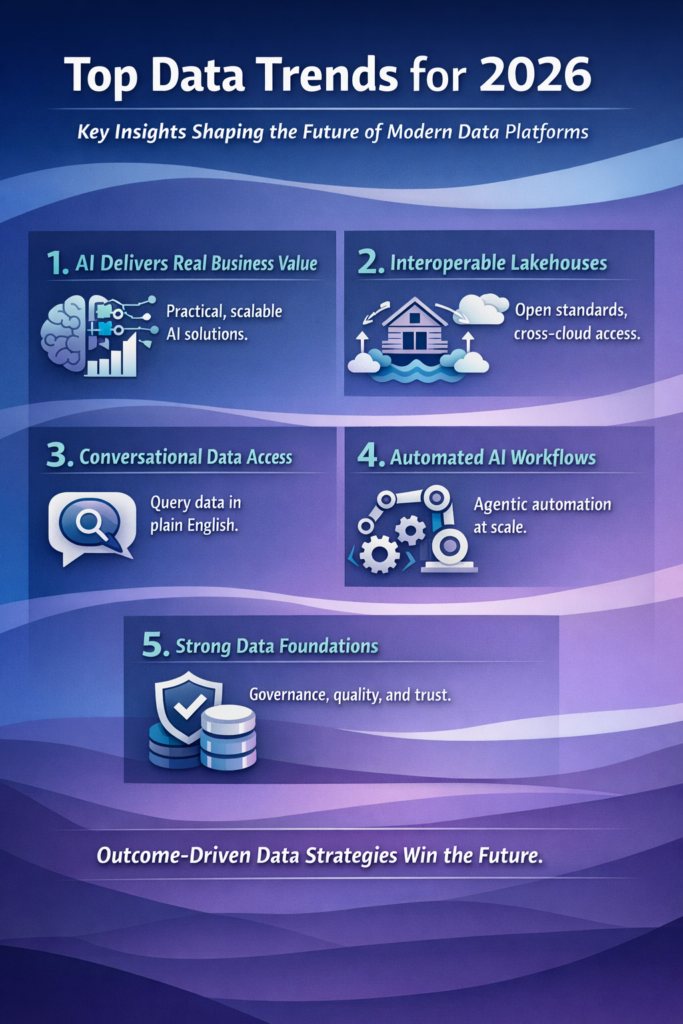
1. AI Moves from Hype to Practical Proof
For years, AI in data felt like “potential” — cool pilots with unclear ROI. In 2026, leaders expect a meaningful shift: AI implementations producing real business value, not just prototypes. The focus is no longer on whether AI works but on how to make it work at scale. Coalesce
This means data teams must stop chasing shiny tools and instead build robust foundations (governance, quality, modeling) that make AI reliable and repeatable.
2. Interoperable Lakehouses and Open Standards Become Core Infrastructure
Legacy silos and monolithic warehouses slow down innovation. The report highlights a strong push toward interoperable lakehouse architectures built on open formats like Iceberg or Delta Lake. Coalesce
Why this matters:
- Enables real-time, cross-cloud data access
- Reduces integration friction
- Powers AI workflows with fresh, governed data
In short: Data architecture is no longer just storage — it’s fuel for intelligence.
3. Natural Language and Conversational Data Access Take Off
By 2026, many businesses will let people query data in plain English. Coalesce
This trend is more than a UX novelty — it democratizes analytics:
- Non-technical teams get insights fast
- SQL expertise isn’t a prerequisite
- Decisions are based on data fluency, not syntax mastery
The semantic layer — once an optional overlay — is now central infrastructure for making data understandable and actionable.
4. Agentic AI and Automation Chains Redefine Workflows
AI isn’t just assisting humans anymore — it’s starting to orchestrate entire pipelines and workflows. Coalesce
The report highlights:
- AI agents automating migrations and ETL tasks
- “Automation of automation” where agents link tasks end-to-end
- Data quality and governance becoming more important, not less
But here’s the twist: AI isn’t replacing data engineers — it’s transforming their role. Teams that master agent-backed automation will unlock 10–100× productivity gains.
5. Strong Data Foundations Win the Competitive Race
Amid all the buzz about AI, the fundamentals — quality, modeling, governance, and readiness — become the real competitive edge. Coalesce
This isn’t about nostalgia for old-school practices; it’s a practical reality:
- AI models fail without reliable data
- Governance ensures trust and compliance
- Quality data accelerates time to value
The report makes it clear: the organizations that win in 2026 are those that treat data as a strategic asset, not a byproduct of apps.
Why This Matters Now
As data and analytics professionals grapple with crowded tool stacks and rising expectations around AI, this report reframes success not as having the most technology but as building the right foundation. Whether you’re a data engineer, analytics leader, or business executive, the message is the same: good data is now the baseline — not the differentiator.
Leave a Reply