Once renewal philosophy is defined, the next — and most consequential — decision is structural:
What is the system of record for renewals in Salesforce?
This question sounds technical, but it’s actually about governance. If Salesforce cannot clearly answer what is renewing and why, everything downstream — forecasting, pricing, automation, billing — becomes fragile.
Most renewal failures aren’t caused by missing automation.
They’re caused by split truth.
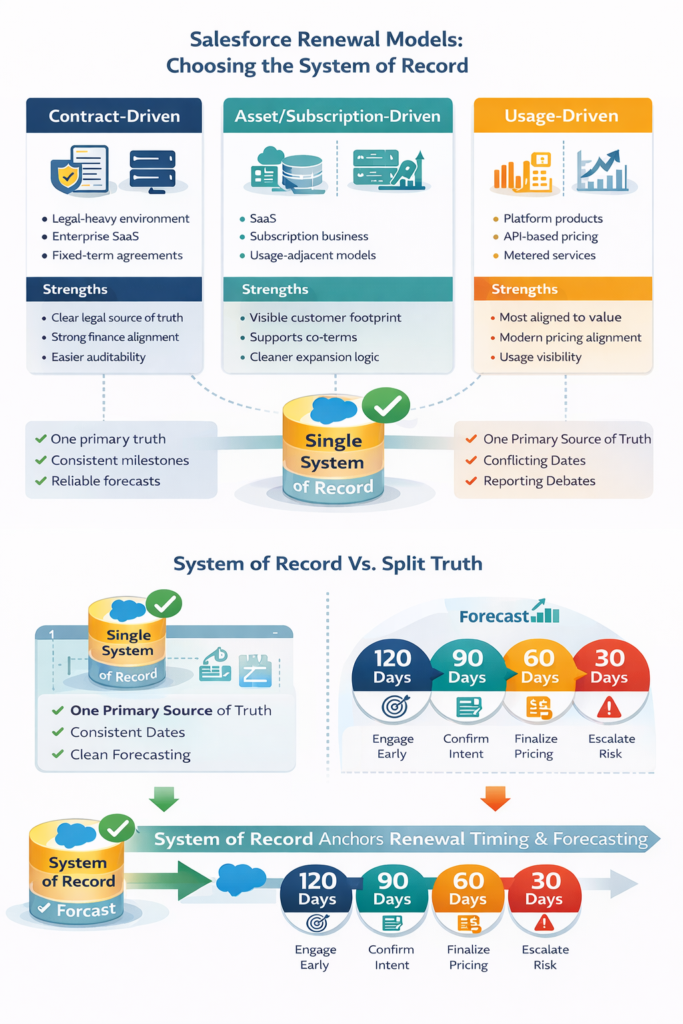
Why “System of Record” Is the Real Renewal Decision
A system of record answers one simple question:
If two numbers disagree, which one do we trust?
In poorly governed Salesforce orgs, renewals are represented in multiple places:
- Opportunities
- Contracts
- Assets
- Subscriptions
- Custom objects
- Spreadsheets “just to be safe”
Each addition feels helpful in the moment. Over time, it creates competing versions of renewal truth — and no one knows which one to believe.
Governance starts by choosing one primary renewal driver.
The Three Common Renewal Models in Salesforce
Nearly every Salesforce org falls into one of these models — whether intentionally or by accident.
1. Contract-Driven Renewals
Renewal is based on a contract end date.
Common in:
- Legal-heavy environments
- Enterprise SaaS
- Fixed-term agreements
Strengths:
- Clear legal source of truth
- Strong alignment with finance
- Easier auditability
Risks:
- Poor handling of partial renewals
- Weak alignment with usage or assets if not modeled carefully
2. Asset / Subscription-Driven Renewals
Renewal is based on active assets or subscriptions.
Common in:
- SaaS
- Subscription businesses
- Usage-adjacent models
Strengths:
- Better representation of what the customer actually has
- Supports co-terms and amendments
- Cleaner expansion logic
Risks:
- Complexity if assets aren’t governed tightly
- Drift if assets aren’t kept in sync with contracts
3. Usage-Driven Renewals
Renewal is based on consumption or entitlement usage.
Common in:
- Platform products
- API-based pricing
- Metered services
Strengths:
- Most accurate reflection of customer value
- Strong alignment with modern pricing models
Risks:
- Requires strong data integration
- Higher governance burden
- Harder to explain without discipline
The Most Common Anti-Pattern: “All of the Above”
Many orgs attempt to support all three models without hierarchy.
Symptoms include:
- Contract dates that don’t match asset dates
- Renewal opportunities created manually “just in case”
- Reports that require explanation every quarter
- Forecast calls spent debating data, not risk
Supporting multiple models is possible — but only with a clear primary system of record.
Governance means:
- One object drives renewal eligibility
- Other objects support or enrich it
- Not the other way around
Decide Where Renewal Dates Truly Live
This is where many implementations quietly fail.
You must decide:
- Where does the authoritative start date live?
- Where does the authoritative end date live?
- Which date triggers renewal opportunity creation?
If term dates are duplicated across objects without enforcement, Salesforce becomes an opinionated system instead of a governed one.
A good rule of thumb:
Dates should exist in multiple places only if one is clearly derived from another.
How This Connects to Forecasting and Timing
Your system of record directly determines:
- When renewals appear in the forecast
- When alerts fire
- When risk escalates
- When leadership trusts the number
If renewal timing milestones (120 / 90 / 60 / 30 days) are anchored to inconsistent dates, alerts become noise and forecasts lose credibility.
Structure precedes automation.
Salesforce Enforces Structure — If You Let It
Platforms like Salesforce are exceptionally good at enforcing structure once decisions are made.
But Salesforce will not:
- Choose the renewal driver for you
- Resolve conflicting dates automatically
- Decide which object “wins”
That responsibility belongs to governance.
When structure is clear:
- Automation becomes simpler
- Reporting becomes trustworthy
- Exceptions become visible instead of hidden
What This Enables Later in the Series
Choosing the system of record unlocks:
- Clean renewal timing automation
- Consistent pricing enforcement
- Accurate renewal forecasting
- Scalable reporting
- Easier Revenue Cloud adoption later
Without it, every downstream decision becomes a workaround.
What Comes Next
This post defined renewal structure.
The next post defines renewal timing enforcement.
➡️ Next: Renewal Timing Governance: Dates, Windows, and Automation
Where we translate renewal structure into alerts, milestones, and forecasting discipline.
Leave a Reply