Once renewal philosophy is defined and a system of record is chosen, governance becomes real in only one way:
Timing.
Renewal timing is where Salesforce stops being a database and starts acting like a revenue system. It determines when renewals appear in forecasts, when risk is surfaced, and when leadership attention is required.
Most renewal failures aren’t caused by bad intent — they’re caused by implicit timing.
Why Timing Is the Fulcrum of Renewal Governance
Timing answers questions leadership actually cares about:
- When should renewals first show up in the forecast?
- When should we know customer intent?
- When should pricing be locked?
- When does a renewal become a problem?
If Salesforce cannot answer those questions consistently, governance doesn’t exist — even if policies are documented.
Strong renewal timing governance makes expectations explicit, visible, and enforceable.
Timing Starts With One Authoritative Date
Everything in renewal timing flows from a single decision:
Which date anchors the renewal lifecycle?
That date must come from the system of record defined in the previous post:
- Contract end date
- Subscription end date
- Usage entitlement expiration
If multiple dates compete, Salesforce cannot enforce milestones reliably. Alerts fire inconsistently, forecasts drift, and teams lose trust.
Governance means:
- One authoritative end date
- All timing logic derived from it
- No manual overrides without visibility
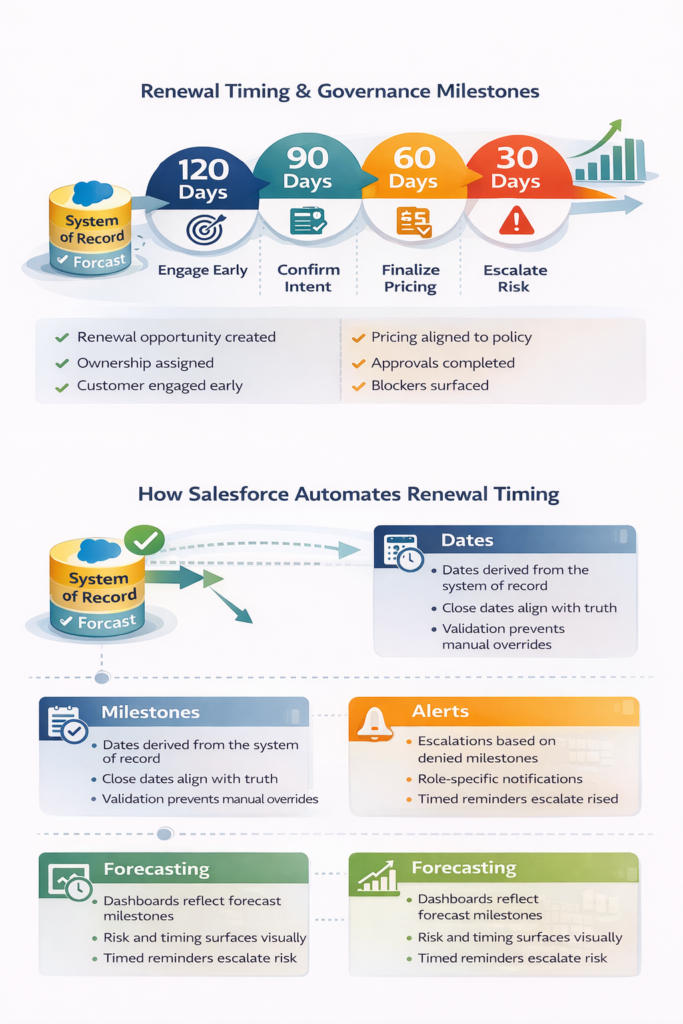
Defining Renewal Milestones (120 / 90 / 60 / 30 Days)
Effective renewal governance defines what “on track” means at each point in time.
A common and effective framework looks like this:
120 Days Out — Engage Early
- Renewal opportunity exists
- Ownership is assigned
- Customer engagement has started
- Renewal is visible in long-range forecasts
This is about awareness, not pressure.
90 Days Out — Confirm Intent
- Customer intent is known or actively pursued
- Retention risk is identified
- Expansion or contraction is surfaced
- Forecast category reflects reality, not optimism
At this stage, surprises are still fixable.
60 Days Out — Finalize Pricing
- Pricing is aligned to policy
- Discounts and increases are resolved
- Approvals are complete or in progress
- Legal or procurement blockers are visible
If pricing isn’t clear at 60 days, governance is already stressed.
30 Days Out — Escalate Risk
- Renewal is either committed or at risk
- Leadership visibility is mandatory
- Exceptions are explicit and documented
- No silent assumptions remain
At this point, Salesforce should make risk impossible to ignore.
Alerts Are a Governance Tool — Not a Crutch
A common mistake is adding alerts without defining milestones.
That leads to:
- Notification fatigue
- Ignored emails
- “We saw it, but it was too late” explanations
Good governance designs alerts after expectations are set.
Salesforce alerts should:
- Trigger only when milestones are missed
- Escalate intentionally, not constantly
- Route to the right role at the right time
Governance is not more alerts.
It’s fewer alerts with meaning.
How Salesforce Enforces Renewal Timing
When timing philosophy is clear, Salesforce can enforce it cleanly through:
- Automated renewal opportunity creation
- Milestone-based stage progression
- Close dates aligned to contract truth
- Validation rules for late-stage movement
- Dashboards that reflect timing health
The goal is simple:
Reps should have to work around governance to ignore renewals — not the other way around.
Timing Is What Makes Forecasts Trustworthy
Renewal forecasts fail when:
- Opportunities appear too late
- Stages don’t map to reality
- Risk isn’t escalated consistently
When renewal timing is governed:
- Forecasts stabilize
- Leadership conversations improve
- Finance trust increases
- Fire drills decrease
Timing discipline is forecasting discipline.
What This Enables Next
With timing enforced, Salesforce can now support:
- Pricing governance
- Approval discipline
- Cross-team accountability
- Executive reporting that doesn’t require explanation
Without timing governance, every downstream control becomes reactive.
What Comes Next in the Series
This post defined when renewals must progress.
➡️ Next: Renewal Pricing Governance: Discounts, Increases, and Exceptions
Where we protect margin by enforcing pricing rules before renewals become urgent.
Leave a Reply