Most revenue problems aren’t sales problems.
They’re systems problems.
Missed forecasts, delayed deals, billing disputes, revenue leakage, and awkward handoffs between sales and finance usually trace back to the same root cause: fragmented revenue tooling stitched together over time.
On paper, the revenue lifecycle is straightforward. In practice, it’s one of the most operationally fragile parts of the modern enterprise.
The Revenue Lifecycle (In Theory)
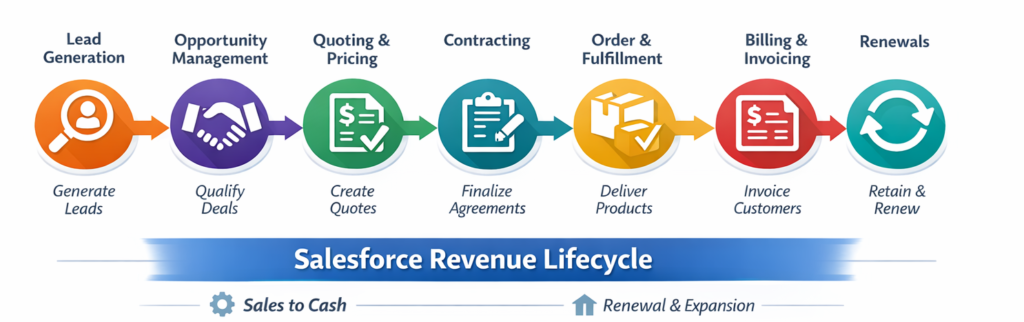
At a high level, revenue follows a predictable path:
- A lead is generated
- An opportunity is qualified
- Customer requirements are gathered
- A quote is created
- A contract is approved and signed
- An order is placed
- The product or service is fulfilled
- The customer is billed
- Payment is received
The ideal outcome is simple:
- The customer gets exactly what they ordered
- The company captures revenue cleanly and accurately
If every step flowed seamlessly, revenue operations would be boring. Unfortunately, that’s rarely the case.
Where Revenue Actually Breaks
Revenue systems tend to fail not because teams are incompetent, but because organizations rely on point solutions — isolated tools designed to solve narrow problems without regard for the end-to-end lifecycle.
Each individual tool may work well on its own:
- A CPQ tool for quotes
- A contract system for approvals
- An order management platform
- A billing system
- A finance system downstream
The problem emerges in the gaps between them.
Common failure points include:
- Pricing delays caused by manual approvals
- Contract bottlenecks due to inconsistent terms
- Order capture errors during handoffs
- Incorrect invoices that don’t reflect contract reality
- Poor support for renewals, proration, bundles, or amendments
- Fragile integrations that break at scale
Every handoff becomes a risk multiplier. Each integration adds cost, latency, and operational exposure. Over time, revenue becomes harder to predict, slower to realize, and more expensive to manage.
The CRO vs. CFO Tension
Revenue breakdowns also create a quiet but persistent tension between leadership roles.
From the Chief Revenue Officer’s perspective:
- Sales teams need speed and flexibility
- Quoting and approvals shouldn’t slow deals
- Visibility across the pipeline is critical
- Stitching together multiple tools creates friction
From the Chief Financial Officer’s perspective:
- Orders must reflect real contract terms
- Invoices must be accurate and auditable
- Revenue data must flow cleanly into financial systems
- Manual corrections introduce risk and compliance exposure
When revenue systems are fragmented, both leaders are forced to compromise. Sales pushes for speed. Finance pushes for control. Neither side fully wins — and revenue suffers as a result.
What “Modern Revenue Management” Actually Requires
A modern revenue management solution isn’t just better quoting software. It must support the entire product-to-cash lifecycle as a cohesive system.
At minimum, it should handle:
- Product and catalog management
- Pricing definition and enforcement
- Configuration workflows
- Quote creation and order capture
- Contract lifecycle management
- Asset and subscription lifecycle tracking
- Order-to-cash execution
- Revenue analytics and intelligence
Just as importantly, it must scale with the business:
- Larger deal sizes
- Higher transaction volumes
- Subscription and usage-based pricing
- Renewals, amendments, and expansions
Future-proof revenue systems are built for automation, compliance, and extensibility — not brittle integrations held together by spreadsheets and tribal knowledge.
Why Unified Revenue Platforms Are Replacing Point Solutions
This is why many organizations are moving away from fragmented revenue stacks toward unified platforms like Salesforce Revenue Cloud.
The appeal isn’t a single feature. It’s the architecture.
Unified revenue platforms:
- Cover the full revenue lifecycle end to end
- Automate handoffs between sales, legal, operations, and finance
- Reduce revenue leakage by enforcing consistency
- Embed revenue intelligence directly into workflows
- Expose APIs that allow extensibility without fragility
Instead of managing revenue as a chain of disconnected events, these platforms treat it as a continuous, governed process.
In other words, they replace revenue guesswork with revenue infrastructure.
The Bottom Line
Revenue doesn’t fail at the close.
It fails in the spaces between systems — where data is re-entered, contracts are reinterpreted, orders are manually adjusted, and invoices no longer reflect reality.
Modern revenue leaders aren’t just optimizing sales motions. They’re rebuilding the revenue engine itself.
Because in today’s environment, revenue isn’t just a sales problem or a finance problem.
It’s a systems problem — and systems either scale, or they break.
Leave a Reply