Artificial intelligence is often framed as a threat to employment. Headlines frequently focus on automation and job displacement.
However, new research from Snowflake, in collaboration with Omdia (by Informa TechTarget), suggests the reality is more nuanced.
In its report “The ROI of Gen AI and Agents,” Snowflake surveyed 2,050 business and technology leaders across 10 countries. The findings challenge the dominant narrative around AI and work.
Instead of widespread job destruction, the report shows a net positive impact on employment, particularly in technical roles such as IT operations, cybersecurity, and software development.
At the same time, the research highlights an important constraint: AI adoption is being limited not by the technology itself, but by data readiness, governance, and skills.
Key Excerpts from the Snowflake Report
On Job Creation vs Job Loss
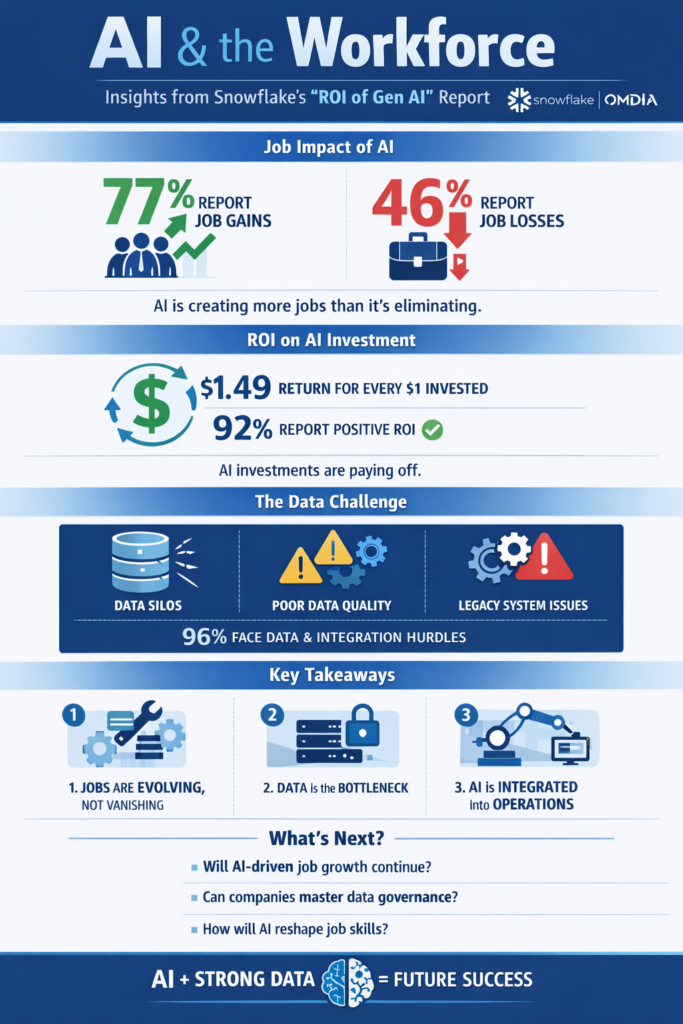
“77% of organizations report AI-driven job creation, compared to 46% reporting job losses.”
This suggests AI adoption is leading to workforce restructuring rather than pure automation-driven layoffs.
On ROI From AI Investments
“Organizations report earning roughly $1.49 for every dollar invested in AI.”
Among early adopters, 92% report positive ROI, reinforcing that AI is moving beyond experimentation into operational value.
On the Real Bottleneck: Data
“96% still face significant challenges with data quality, integration with legacy systems, and employee skills.”
In other words, the limiting factor is not AI capability—it is organizational readiness.
Three Takeaways
1. AI Is Reshaping Jobs, Not Eliminating Them
The research shows both job creation and job loss occurring simultaneously.
The strongest gains are in technical roles:
- IT operations (+56%)
- Cybersecurity (+46%)
- Software development (+38%)
Meanwhile, roles like customer service and data analytics are seeing reductions as repetitive tasks become automated.
The broader pattern: AI changes the composition of work rather than simply reducing it.
2. Data Infrastructure Is the Real Competitive Advantage
Nearly 8 out of 10 organizations report data challenges when scaling AI.
Key issues include:
- Data silos
- Poor data quality
- Lack of AI-ready datasets
Only 7% of organizations say most of their unstructured data is AI-ready, highlighting a major gap between AI ambition and operational reality.
3. AI Is Becoming Embedded in Everyday Operations
The report shows AI is rapidly moving into production environments.
Examples include:
- 62% of IT operations teams using AI
- 59% of data analytics teams using AI
- 53% of cybersecurity teams using AI
One striking statistic:
Nearly 48% of all code is now AI-generated.
This signals that AI is no longer a novelty—it is becoming a core layer of enterprise productivity.
Three Questions for the Future
1. Will Workforce Growth Continue as AI Matures?
Early adopters report net job creation, but as automation improves, the balance between job creation and elimination could shift.
The long-term employment trajectory remains uncertain.
2. Will Data Governance Become the New Strategic Discipline?
If AI success depends on trusted data infrastructure, organizations may increasingly compete on data governance, data quality, and architecture, not just algorithms.
3. How Will AI Change the Skill Requirements of Knowledge Work?
If nearly half of all code is AI-generated, the role of professionals may shift toward:
- AI orchestration
- problem framing
- system supervision
This could redefine what expertise looks like across technical and business roles.
Closing Thought
Snowflake’s research highlights a key reality: AI’s impact on work is more evolutionary than revolutionary.
The biggest winners may not simply be the organizations that adopt AI fastest—but those that combine AI capability with strong data infrastructure, governance, and workforce skills.
The future of work will likely be shaped by a simple equation:
AI capability + data readiness + human expertise = sustainable competitive advantage.
Pingback: What Lawyers Should Know About AI and Jobs – wvlawyerhelp.com
Pingback: AI and Client Confidentiality: What Lawyers Must Consider – wvlawyerhelp.com
Pingback: AI and Document Review in Litigation - wvlawyerhelp.com
Pingback: Will AI Replace Lawyers? A More Realistic Answer - wvlawyerhelp.com
Pingback: The New Legal Skillset in an AI-Enabled Profession - wvlawyerhelp.com