The winners are not necessarily the companies with the flashiest models.
They’re the companies with: • clean data foundations • measurable business outcomes • governance structures • workforce readiness • scalable workflows
One of the strongest takeaways:
👉 AI activity is not the same thing as AI impact.
Many organizations are deploying pilots everywhere, but very few are rigorously measuring whether AI is actually improving revenue, margins, decision-making, or customer experience.
Another major insight: The biggest AI costs are not the models themselves.
The real burden is: • data movement • duplication • integration • governance • human review
The report also warns that autonomous AI agents will amplify existing organizational weaknesses.
Strong systems scale. Weak systems become more fragile.
The companies pulling ahead are operationalizing AI — not just experimenting with it.
Most companies are confusing AI activity with AI impact Companies are launching pilots everywhere, but very few are rigorously measuring whether AI is actually improving revenue, margins, customer experience, or operational efficiency. The report notes that more than 4 in 5 executives say AI is outperforming expectations — yet only about 2 in 5 companies formally require teams to track business outcomes.
👉 Translation: A growing list of AI experiments does not equal transformation.
Data infrastructure—not models—is the real battleground The report repeatedly emphasizes that the biggest ongoing AI cost is not compute. It’s data movement, duplication, storage, and integration. Companies with unified data architectures are seeing dramatically faster ROI from AI investments.
One of the strongest lines in the report:
“The gap between building a prototype on clean data and running AI at enterprise scale is ‘not even in the same universe.’”
👉 This is a massive point for enterprise leaders: AI success increasingly belongs to companies that cleaned up their data plumbing years ago.
The hardest part of AI is organizational change—not the technology One of the report’s biggest themes is that culture, workflow redesign, and employee readiness matter more than model sophistication.
The report even describes many companies as having:
“a Ferrari, but no driver.”
That’s a powerful metaphor.
Many organizations are buying advanced AI capabilities without redesigning workflows, retraining employees, or changing incentives.
👉 AI adoption without operational redesign creates friction, distrust, and stalled execution.
Most firms are stuck in “pilot purgatory” About 3 in 5 companies take 7–12 months just to move an AI project into production. Many lack a structured AI development lifecycle entirely.
The companies breaking through share three traits:
structured governance
disciplined project evaluation
reusable systems and workflows
👉 The takeaway: Winning companies aren’t just experimenting faster. They’re operationalizing faster.
AI agents amplify existing weaknesses inside companies The report argues that autonomous AI agents are exposing weak governance, fragmented systems, and poor oversight structures. About 3 in 5 leading AI adopters already have agents doing real work, but fewer than half have formal governance frameworks for them.
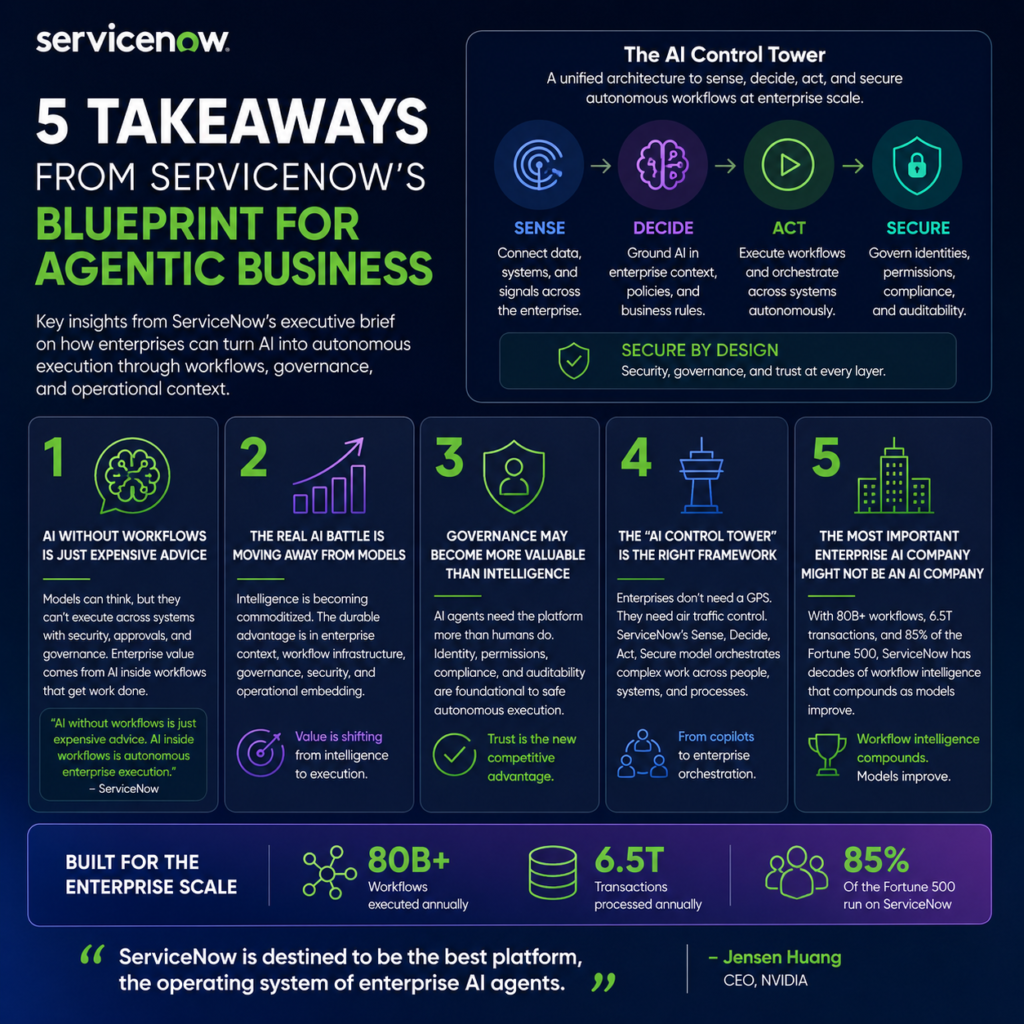
ServiceNow’s “Blueprint for Agentic Business” argues that the future winners in enterprise AI will not simply have the smartest models — they’ll have the best systems for governing, orchestrating, securing, and operationalizing AI across real enterprise workflows.
Here are my five biggest takeaways.
1. AI Without Workflows Is Just “Expensive Advice”
This was probably the strongest line in the document:
“AI without workflows is just expensive advice. AI inside workflows is autonomous enterprise execution.”
That’s the real shift happening right now.
Most AI tools today are impressive at:
reasoning
summarizing
generating content
coding
answering questions
But enterprises don’t simply need answers.
They need:
approvals
audit trails
identity management
governance
cross-system execution
compliance
orchestration
An AI model can explain how a payroll issue happened.
But can it:
securely access the right systems,
validate entitlements,
trigger approvals,
coordinate across HR/payroll/finance,
and create an auditable compliance trail?
That’s the difference between:
intelligence vs.
operational execution.
And ServiceNow is positioning itself as the operating layer for that execution.
2. The Real AI Battle Is Moving Away from Models
One of the smartest observations in the brief:
AI models are rapidly becoming commoditized.
The competitive advantage is shifting toward:
enterprise context,
workflow infrastructure,
governance,
security,
and operational embedding.
That’s an important mental model.
The industry conversation often revolves around:
benchmark scores,
context windows,
parameter counts,
and which model is “best.”
But ServiceNow argues the long-term moat is not raw intelligence.
It’s:
where the AI lives,
what systems it can access,
and whether it can safely execute work.
That feels directionally correct.
Because enterprises don’t buy “cool AI.”
They buy:
reduced friction,
lower labor costs,
faster resolutions,
lower compliance risk,
and operational leverage.
3. Governance May Become More Valuable Than Intelligence
This section stood out:
“AI agents need the platform more than humans do.”
That’s a profound insight.
Humans naturally understand:
organizational boundaries,
sensitive information,
approval structures,
and social context.
AI agents do not.
The more powerful AI becomes, the more dangerous ungoverned execution becomes.
That means:
identity resolution,
permissions,
auditability,
entitlement management,
and workflow controls
become foundational infrastructure.
This is where ServiceNow believes it has an advantage:
20+ years of workflow history,
enterprise integrations,
security architecture,
and embedded operational context.
In other words:
The future AI winner may not be the company with the smartest model.
It may be the company enterprises trust to safely operationalize the models.
4. “AI Control Tower” Is a Powerful Framing Device
ServiceNow repeatedly uses the phrase:
“AI Control Tower.”
And honestly, it’s effective positioning.
The document compares:
a GPS vs.
air traffic control.
A GPS helps an individual.
Air traffic control coordinates an entire system.
That’s the distinction ServiceNow is trying to create:
not AI assistants,
but enterprise orchestration.
The framework breaks into four layers:
Sense
Connect enterprise data and systems.
Decide
Ground AI in enterprise policies and context.
Act
Execute workflows autonomously.
Secure
Govern identities, permissions, compliance, and auditability.
That architecture is probably the clearest articulation I’ve seen yet of how enterprise AI actually becomes operational at scale.
5. The Most Important Enterprise AI Company Might Not Be an AI Company
This may be the biggest strategic takeaway.
ServiceNow is effectively arguing:
the model layer commoditizes,
but workflow orchestration compounds.
That’s a fascinating thesis.
The company cites:
80B+ workflows annually,
6.5T transactions,
and deployment inside 85% of the Fortune 500.
That creates something difficult to replicate:
institutional workflow intelligence,
embedded governance,
operational history,
and enterprise relationships.
And importantly: ServiceNow doesn’t need to “win” the foundation model race.
It benefits as models improve.
That’s a strong strategic position if the market evolves the way they expect.
Final Thought
The most interesting thing about this document is that it reframes enterprise AI away from:
chatbots,
copilots,
and model comparisons
and toward:
operational systems,
workflow execution,
governance,
and enterprise trust.
That feels much closer to where real enterprise value creation will happen.
The winners in AI may not simply be the companies with the smartest intelligence.
They may be the companies that can safely turn intelligence into action.