Artificial intelligence is quickly moving from chatbot novelty to enterprise infrastructure.
But one of the biggest insights from ServiceNow’s new executive brief is this:
AI is not the product anymore.
Execution is.
ServiceNow’s “Blueprint for Agentic Business” argues that the future winners in enterprise AI will not simply have the smartest models — they’ll have the best systems for governing, orchestrating, securing, and operationalizing AI across real enterprise workflows.
Here are my five biggest takeaways.
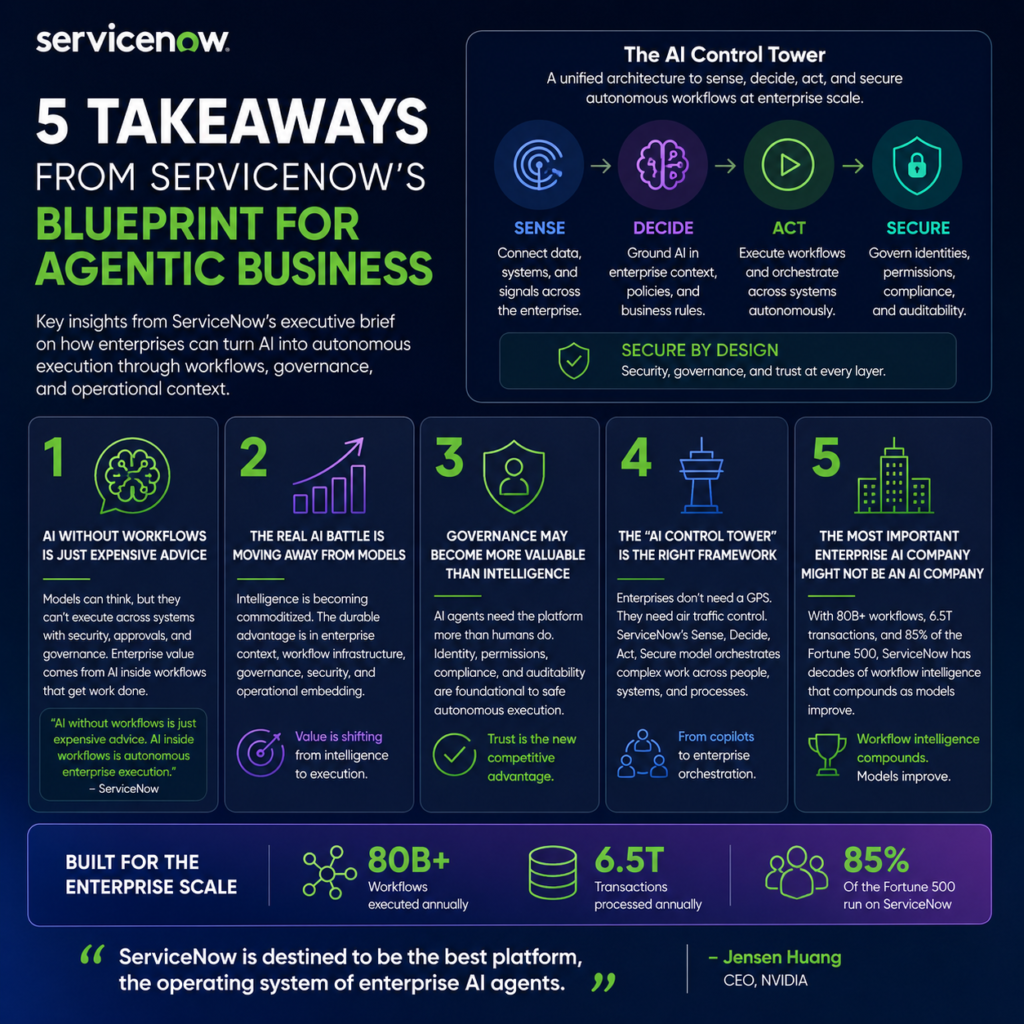
1. AI Without Workflows Is Just “Expensive Advice”
This was probably the strongest line in the document:
“AI without workflows is just expensive advice. AI inside workflows is autonomous enterprise execution.”
That’s the real shift happening right now.
Most AI tools today are impressive at:
- reasoning
- summarizing
- generating content
- coding
- answering questions
But enterprises don’t simply need answers.
They need:
- approvals
- audit trails
- identity management
- governance
- cross-system execution
- compliance
- orchestration
An AI model can explain how a payroll issue happened.
But can it:
- securely access the right systems,
- validate entitlements,
- trigger approvals,
- coordinate across HR/payroll/finance,
- and create an auditable compliance trail?
That’s the difference between:
- intelligence
vs. - operational execution.
And ServiceNow is positioning itself as the operating layer for that execution.
2. The Real AI Battle Is Moving Away from Models
One of the smartest observations in the brief:
AI models are rapidly becoming commoditized.
The competitive advantage is shifting toward:
- enterprise context,
- workflow infrastructure,
- governance,
- security,
- and operational embedding.
That’s an important mental model.
The industry conversation often revolves around:
- benchmark scores,
- context windows,
- parameter counts,
- and which model is “best.”
But ServiceNow argues the long-term moat is not raw intelligence.
It’s:
- where the AI lives,
- what systems it can access,
- and whether it can safely execute work.
That feels directionally correct.
Because enterprises don’t buy “cool AI.”
They buy:
- reduced friction,
- lower labor costs,
- faster resolutions,
- lower compliance risk,
- and operational leverage.
3. Governance May Become More Valuable Than Intelligence
This section stood out:
“AI agents need the platform more than humans do.”
That’s a profound insight.
Humans naturally understand:
- organizational boundaries,
- sensitive information,
- approval structures,
- and social context.
AI agents do not.
The more powerful AI becomes, the more dangerous ungoverned execution becomes.
That means:
- identity resolution,
- permissions,
- auditability,
- entitlement management,
- and workflow controls
become foundational infrastructure.
This is where ServiceNow believes it has an advantage:
- 20+ years of workflow history,
- enterprise integrations,
- security architecture,
- and embedded operational context.
In other words:
The future AI winner may not be the company with the smartest model.
It may be the company enterprises trust to safely operationalize the models.
4. “AI Control Tower” Is a Powerful Framing Device
ServiceNow repeatedly uses the phrase:
“AI Control Tower.”
And honestly, it’s effective positioning.
The document compares:
- a GPS
vs. - air traffic control.
A GPS helps an individual.
Air traffic control coordinates an entire system.
That’s the distinction ServiceNow is trying to create:
- not AI assistants,
- but enterprise orchestration.
The framework breaks into four layers:
Sense
Connect enterprise data and systems.
Decide
Ground AI in enterprise policies and context.
Act
Execute workflows autonomously.
Secure
Govern identities, permissions, compliance, and auditability.
That architecture is probably the clearest articulation I’ve seen yet of how enterprise AI actually becomes operational at scale.
5. The Most Important Enterprise AI Company Might Not Be an AI Company
This may be the biggest strategic takeaway.
ServiceNow is effectively arguing:
- the model layer commoditizes,
- but workflow orchestration compounds.
That’s a fascinating thesis.
The company cites:
- 80B+ workflows annually,
- 6.5T transactions,
- and deployment inside 85% of the Fortune 500.
That creates something difficult to replicate:
- institutional workflow intelligence,
- embedded governance,
- operational history,
- and enterprise relationships.
And importantly:
ServiceNow doesn’t need to “win” the foundation model race.
It benefits as models improve.
That’s a strong strategic position if the market evolves the way they expect.
Final Thought
The most interesting thing about this document is that it reframes enterprise AI away from:
- chatbots,
- copilots,
- and model comparisons
and toward:
- operational systems,
- workflow execution,
- governance,
- and enterprise trust.
That feels much closer to where real enterprise value creation will happen.
The winners in AI may not simply be the companies with the smartest intelligence.
They may be the companies that can safely turn intelligence into action.
Source: ServiceNow, Blueprint for Agentic Business – The Executive Brief
Leave a Reply