Sales forecasting is often treated like a math problem.
It is not.
Most forecast problems begin long before a number ever reaches a spreadsheet or CRM dashboard. Forecast accuracy is ultimately a systems problem involving sales behavior, stage discipline, data quality, management pressure, and operational visibility.
In many organizations, the issue is not a lack of reporting. It is an overload of disconnected metrics that fail to reflect actual buyer behavior.
A predictable revenue system requires more than quarterly optimism and pipeline reviews. It requires disciplined definitions, connected data, and a shared understanding of what real deal progression actually looks like.
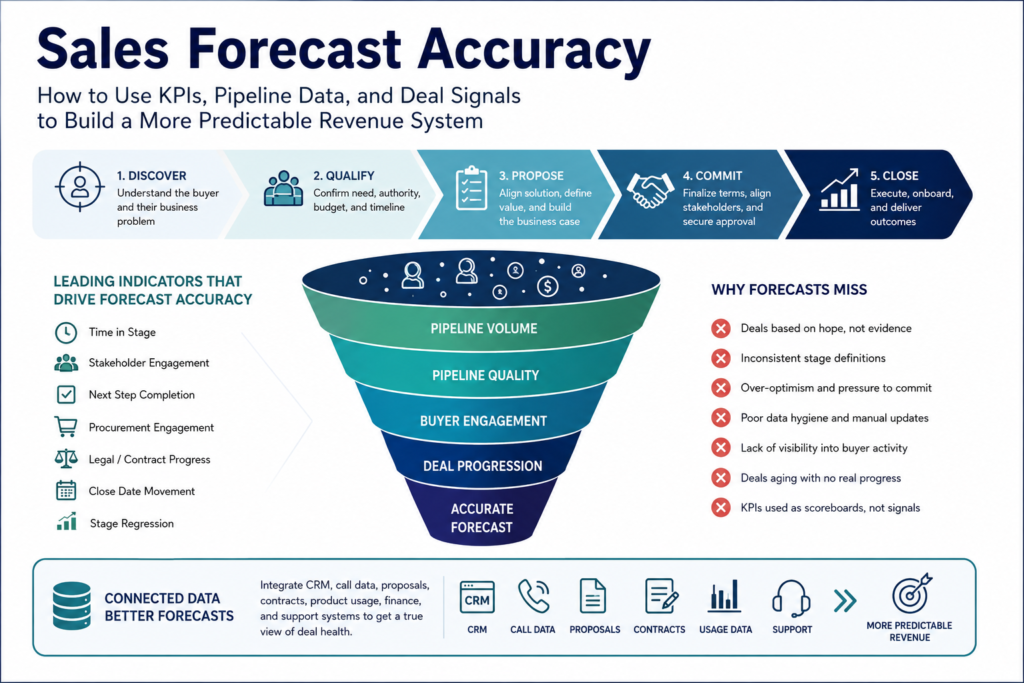
Why Forecast Accuracy Breaks Down
Most forecast misses do not happen because finance teams cannot calculate revenue correctly.
They happen because the underlying sales data was flawed from the beginning.
Common causes include:
- Reps forecasting based on hope instead of evidence
- Undefined or inconsistent stage criteria
- Pressure to inflate commit numbers
- CRM hygiene problems
- Lack of visibility into buyer-side activity
- Deals remaining open long after momentum has died
- Leadership rewarding optimism instead of accuracy
In many companies, the CRM becomes less of a source of truth and more of a political document.
The result is predictable:
- Pipeline inflation
- Missed forecasts
- Resource misallocation
- Hiring mistakes
- Unrealistic board expectations
- Operational chaos
Forecasting improves when organizations stop treating it as a spreadsheet exercise and start treating it as a revenue operating system.
KPIs Are Leading Indicators, Not Scoreboards
One of the biggest mistakes in sales leadership is using KPIs as historical scoreboards instead of operational indicators.
Revenue is a lagging indicator.
By the time revenue declines, the real problems likely began months earlier.
Strong revenue organizations monitor leading indicators that reveal whether pipeline quality and buyer engagement are improving or deteriorating before quarter-end pressure arrives.
Examples of valuable leading indicators include:
- Time in stage
- Multi-threading across stakeholders
- Next-step completion rates
- Proposal turnaround time
- Procurement engagement
- Legal review initiation
- Meeting frequency
- Opportunity aging
- Close date movement
- Stage regression frequency
These signals matter because they reflect buyer movement, not seller confidence.
A healthy forecasting culture focuses less on “What number are we calling?” and more on “What evidence supports the number?”
Forecasting Is a Behavior Problem, Not a Math Problem
Most forecasting failures are behavioral before they are analytical.
Sales teams are often incentivized to present confidence rather than accuracy.
That creates predictable distortions:
- Sandbagging
- Artificial pipeline inflation
- End-of-quarter optimism
- Deals sitting in commit without buyer movement
- Managers overriding reality to protect expectations
Forecasting systems become unreliable when organizations reward enthusiasm over evidence.
For example, a rep may believe a deal is highly likely because the relationship feels strong. But if procurement has not engaged, legal has not reviewed terms, and no implementation planning has begun, the opportunity may still be immature.
The problem is not intent. The problem is confusing seller emotion with operational reality.
Predictable revenue systems reduce ambiguity by defining what progression actually means.
Why Deals Stall in Commit
Many organizations treat the commit stage as a confidence bucket.
That is dangerous.
A deal should not enter commit because a seller “feels good” about it. It should enter commit because objective signals indicate meaningful buyer-side progression.
When commit discipline weakens, several things happen:
- Forecast volatility increases
- Leadership loses confidence in CRM data
- Pipeline reviews become emotional debates
- Quarter-end surprises become normal
Common warning signs of unhealthy commit-stage deals include:
- No scheduled next step
- Repeated close date movement
- Single-threaded relationships
- No procurement engagement
- Undefined implementation timelines
- No legal activity
- Low executive involvement
- Large periods of inactivity
One of the most valuable exercises for revenue leaders is analyzing historical commit-stage slippage.
Patterns usually emerge quickly.
For example:
- Deals over a certain age may rarely close
- Single-threaded enterprise opportunities may consistently slip
- Opportunities without procurement engagement may have low conversion rates
- Certain industries may experience longer legal cycles
This is where forecasting evolves from opinion into operational intelligence.
When a Deal Is Real Enough to Forecast
Forecast inclusion should be evidence-based.
A deal is not forecastable simply because it exists in the CRM.
A healthier approach is defining objective qualification standards for forecast inclusion.
A forecastable opportunity often includes:
Confirmed Business Problem
The buyer has clearly articulated a real operational, financial, or strategic issue.
Identified Decision Process
The organization understands how purchasing decisions are made and who is involved.
Economic Buyer Access
Someone with budget authority or strategic influence is engaged.
Defined Timeline
There is a credible business reason for action within a specific timeframe.
Mutual Action Plan
Both sides understand the next steps required to move forward.
Procurement or Legal Engagement
Operational buying processes have started.
Implementation Awareness
The customer is thinking beyond evaluation and into deployment or adoption.
The key principle is simple:
Forecast confidence should increase when buyer-side evidence increases.
Avoiding KPI Myopia in High-Value Deals
Metrics are useful.
Overreliance on metrics can become dangerous.
Not every high-value opportunity behaves like a transactional sales motion.
Enterprise deals often involve:
- Longer decision cycles
- Complex procurement processes
- Executive sponsorship
- Budget realignment
- Legal negotiation
- Cross-functional approval
A dashboard may flag these opportunities as “stalled” even when strategic progress is occurring behind the scenes.
This is where experienced sales leadership matters.
Revenue systems should support judgment, not replace it.
KPI myopia occurs when organizations optimize for metric appearance instead of revenue quality.
Examples include:
- Prioritizing activity volume over strategic conversations
- Overemphasizing call counts
- Penalizing legitimate deal-cycle complexity
- Forcing unrealistic close dates for reporting optics
- Treating every opportunity equally regardless of strategic value
Strong forecasting systems combine quantitative signals with operational context.
The Pipeline Signals Revenue Leaders Should Monitor
Forecasting improves dramatically when organizations focus on pipeline health signals instead of isolated revenue targets.
Important operational signals include:
| Signal | Why It Matters |
|---|---|
| Opportunity aging | Older deals often have lower conversion probability |
| Stage regression | Deals moving backward indicate instability |
| Close date movement | Repeated pushes reduce forecast confidence |
| Stakeholder engagement | Multi-threaded deals are generally healthier |
| Procurement involvement | Indicates operational buying momentum |
| Legal activity | Often signals late-stage seriousness |
| Next-step completion | Reveals execution discipline |
| Forecast change history | Shows consistency and predictability |
| Pipeline source quality | Some channels produce healthier opportunities |
| Time-to-proposal | Operational efficiency impacts conversion |
Over time, these signals create a more realistic view of revenue predictability than simple pipeline totals alone.
Why Connected Data Matters in Forecasting
Forecasting becomes difficult when critical operational data is fragmented across disconnected systems.
Many organizations have useful signals trapped inside:
- CRM platforms
- ERP systems
- Contract systems
- Proposal tools
- Call recording platforms
- Customer success platforms
- Marketing automation systems
- Finance systems
- Support platforms
The challenge is not a lack of data.
The challenge is operational visibility.
For example:
- CRM shows a deal is in commit
- But call activity has declined
- Legal has not engaged
- Product usage is low
- Procurement communication has stopped
- No implementation resources have been discussed
Without connected data, leadership sees an incomplete picture.
This is where modern data engineering and RevOps infrastructure become critical.
Custom data pipelines can help organizations:
- Consolidate pipeline signals
- Improve forecasting visibility
- Standardize KPI definitions
- Track buyer progression
- Identify forecast risk patterns
- Build more accurate reporting systems
- Reduce manual forecasting effort
- Improve executive decision-making
Better forecasting is not simply about better dashboards.
It is about creating a cleaner operational system underneath the dashboard.
Final Thoughts
Sales forecasting will never be perfect.
But it can become dramatically more reliable when organizations stop treating forecasting as a quarterly ritual and start treating it as a connected operational discipline.
Predictable revenue systems are built through:
- Clear stage definitions
- Strong CRM hygiene
- Behavioral accountability
- Evidence-based forecasting
- Connected operational data
- KPI discipline
- Leadership consistency
The best forecasting organizations are not necessarily the most optimistic.
They are the most operationally honest.
Leave a Reply