Before you build renewal workflows, fields, or automation in Salesforce, you need to answer a simpler — and more important — question:
What does a renewal mean in your business?
Most Salesforce renewal issues don’t originate in bad configuration. They originate in unclear philosophy. When leadership hasn’t defined how renewals should work, Salesforce faithfully reflects that ambiguity — at scale.
This post focuses on defining renewal intent before system design, so governance doesn’t have to be retrofitted later.
Why Renewal Philosophy Comes First
Salesforce is excellent at enforcing rules.
It is terrible at inventing them.
When renewal philosophy is unclear, teams compensate with:
- Exceptions
- Manual workarounds
- Shadow spreadsheets
- “We’ll fix it later” logic
Those decisions compound quietly until renewals become unpredictable, political, and hard to forecast.
A clear renewal philosophy gives Salesforce something concrete to enforce.
Question 1: Who Owns the Renewal?
This is the most common source of renewal breakdown.
You must explicitly decide:
- Is the renewal owned by the Account Executive?
- A dedicated Account Manager?
- Customer Success?
- Or a shared, staged handoff?
Each model has implications:
- Sales-led renewals favor expansion
- CS-led renewals favor continuity
- Shared models require explicit system handoffs
If ownership changes during the lifecycle, Salesforce must reflect when and why. Ambiguity here guarantees friction later.
Question 2: What Is Actually Renewing?
Many organizations talk about renewals without agreeing on what renews.
Common answers include:
- Contracts
- Subscriptions
- Assets
- Usage entitlements
Problems arise when the answer is “all of the above” — without hierarchy.
Your philosophy should clearly state:
- What object represents the renewable unit
- What triggers renewal eligibility
- What defines term start and end
Salesforce cannot govern renewals cleanly if the business itself hasn’t decided what the renewal is.
Question 3: How Are Renewals Priced?
Renewal pricing should not be an emotional conversation.
You must define:
- Are renewals flat, escalated, or renegotiated?
- Are price increases automatic or discretionary?
- Are discounts allowed by default or by exception?
- Do renewals follow the same pricing logic as new deals?
If renewal pricing is undefined, reps will default to discounting — not because they’re careless, but because the system allows it.
A clear pricing philosophy enables Salesforce to enforce guardrails instead of relying on after-the-fact approvals.
Question 4: Are Renewals Opt-In or Opt-Out?
This decision has operational and reputational consequences.
You should decide:
- Do renewals require affirmative action?
- Are customers auto-renewed unless they cancel?
- Is notice required, and if so, when?
Salesforce can automate notices, timing, and opportunity creation — but only if renewal intent is explicit.
Silent assumptions create customer disputes and internal confusion.
Question 5: What Is the Renewal Timing Philosophy?
Renewal governance is not just about what renews — it’s about when the organization engages.
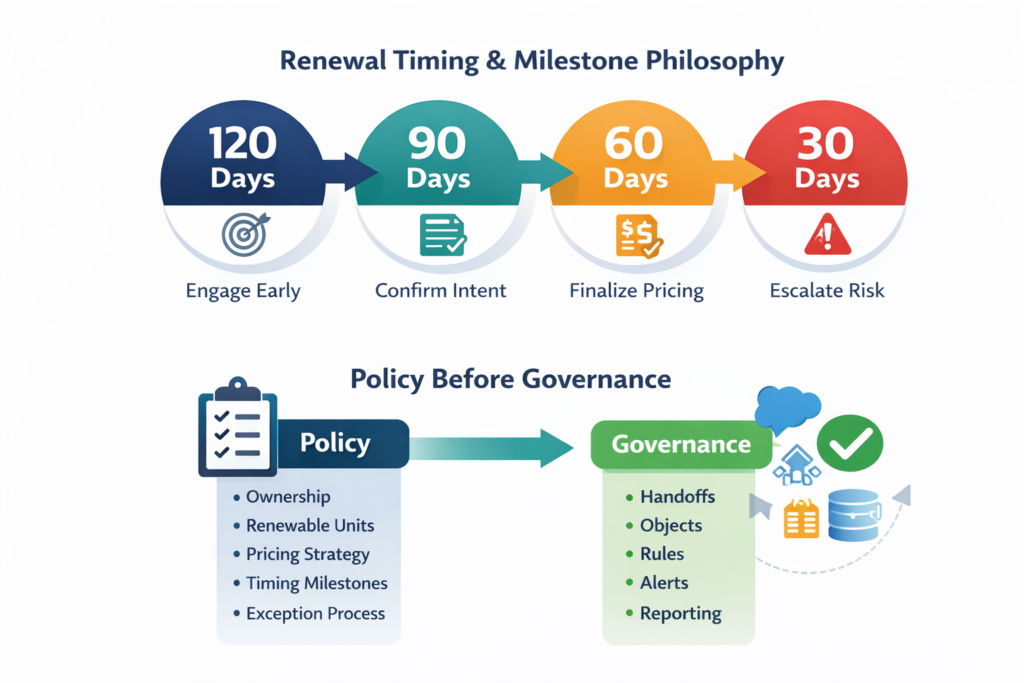
Before touching Salesforce alerts or automation, leadership must define timing expectations:
- When should renewals first appear in forecasts?
- When should risk be escalated?
- When should leadership care?
Strong renewal philosophy answers questions like:
- What milestones should be hit 120 days out?
- What should be confirmed 90 days out?
- What signals matter at 60 days?
- What is considered late or at-risk at 30 days?
Without these answers, alerts become noise and forecasts lose credibility.
A common failure pattern is creating Salesforce alerts without defining why they exist. Notifications fire, emails go unread, and renewal risk is discovered too late to influence outcomes.
Timing philosophy should clearly define:
- When renewal opportunities must be created
- When customer intent should be known
- When pricing and approvals should be resolved
- When escalation is mandatory
Salesforce can enforce milestones, generate alerts, and surface risk — but only if the business agrees on what “on track” actually means at each stage.
Governance is not about more alerts.
It’s about the right alerts, tied to meaningful milestones.
Question 6: What Is the Default, and What Is the Exception?
Strong governance always defines the default path.
Ask:
- What should happen 80–90% of the time?
- Which scenarios truly require exceptions?
- How are exceptions approved and tracked?
Salesforce works best when:
- The default is automated
- Exceptions are visible
- Deviations are intentional, not accidental
A renewal philosophy that treats everything as an exception guarantees governance failure.
How This Translates Into Salesforce (At a High Level)
Once renewal philosophy is defined, Salesforce becomes a tool of enforcement rather than interpretation.
Platforms like Salesforce are most effective when:
- Ownership is explicit
- Objects have clear purpose
- Pricing rules are intentional
- Timing is system-driven
Without philosophy, even the best configuration drifts.
Why This Matters More Than Configuration
Teams often rush to build:
- Renewal opportunity automation
- Reports and dashboards
- Alerts and reminders
But without a defined renewal philosophy, those features simply accelerate inconsistency.
Salesforce scales clarity — and it also scales confusion.
Define the philosophy first. Governance follows naturally.
➡️ Next: Choosing the System of Record for Renewals in Salesforce
Where we decide which object owns renewal truth — and why most orgs get it wrong.
Leave a Reply