When organizations begin evaluating modern data platforms such as Snowflake, much of the discussion focuses on analytics, dashboards, artificial intelligence, and business intelligence. Executives envision a future where data is available on demand, reports update automatically, and decision-makers can answer complex questions in minutes rather than days.
What many organizations discover, however, is that the biggest challenge is not analyzing the data. The biggest challenge is getting the data into the platform in the first place.
This challenge is often referred to as the “First Mile” problem.
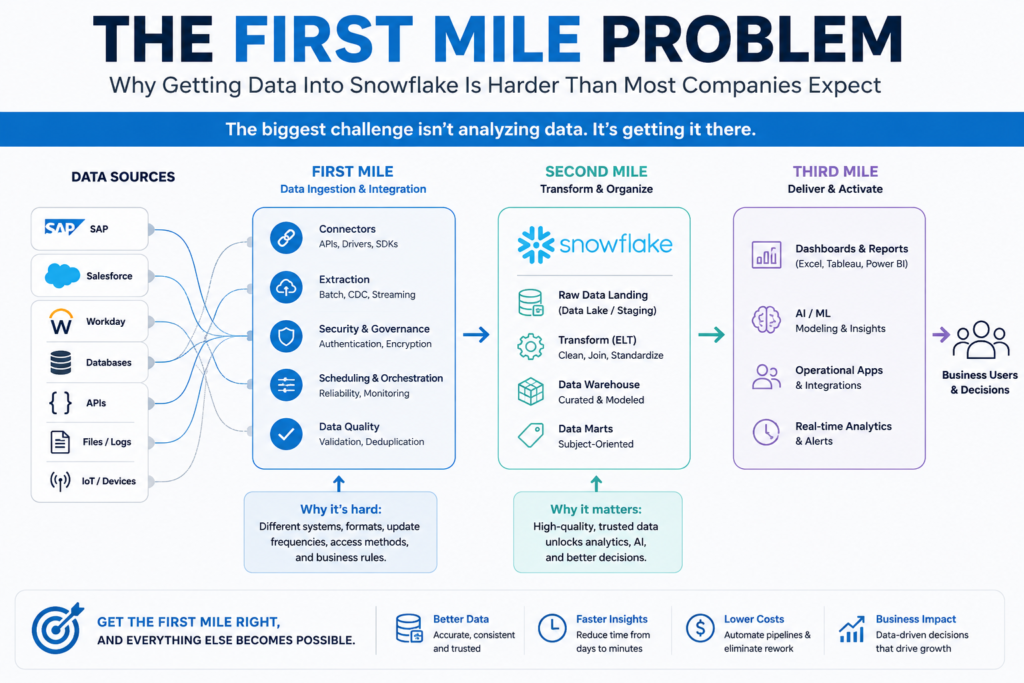
What Is the First Mile?
The First Mile represents the process of extracting data from source systems and loading it into a modern analytical platform such as Snowflake.
Most businesses operate dozens or even hundreds of systems that generate data every day. These systems may include:
- ERP platforms such as SAP
- CRM systems such as Salesforce
- Financial applications
- Manufacturing systems
- E-commerce platforms
- Custom applications
- Web logs
- APIs
- IoT devices
Each of these systems stores information differently. Some use relational databases. Others rely on APIs. Some generate files. Others stream events in real time.
Before a company can analyze its data, all of these sources must be connected, extracted, and loaded into a central repository.
That sounds straightforward in theory. In practice, it is often the most difficult part of the project.
Why Data Extraction Is So Challenging
Organizations frequently underestimate the complexity of moving data.
Consider a manufacturing company that operates:
- SAP for ERP
- Salesforce for CRM
- A custom production scheduling system
- Several Excel-based workflows
- Third-party logistics software
Each platform has different data models, security requirements, update frequencies, and integration methods.
The sales team may define a customer one way. Finance may define that same customer differently. Operations may maintain yet another version.
Before analytics can begin, these differences must be reconciled.
This is why data integration often consumes more project time than dashboard development or reporting.
The Water Treatment Plant Analogy
One useful way to think about data movement is through the lens of a water treatment facility.
Water arrives from multiple sources:
- Rivers
- Lakes
- Reservoirs
- Groundwater systems
Before the water reaches homes and businesses, it must be cleaned, filtered, processed, and distributed.
Data follows a remarkably similar path.
Raw data enters from multiple operational systems. It is extracted, moved through pipelines, cleansed, standardized, and eventually delivered to business users through dashboards, reports, and analytics tools.
The report may be what executives see, but the pipeline behind the report is where most of the work happens.
Why Snowflake Relies on an Ecosystem
One misconception about Snowflake is that it automatically connects to every source system and extracts all required data.
In reality, Snowflake excels at storing, transforming, and analyzing data at scale. Data extraction is often handled by specialized integration platforms.
This is where tools such as:
- Fivetran
- Informatica
- Matillion
- Airbyte
- dbt
play a critical role.
These platforms help organizations solve the First Mile problem by connecting source systems to Snowflake and automating data movement.
Rather than building hundreds of custom integrations, companies can leverage existing connectors and integration frameworks.
The Business Impact
The First Mile problem is not just a technical challenge.
It has direct business implications.
When data cannot be extracted efficiently:
- Analytics projects stall
- Reporting becomes inconsistent
- Decision-making slows
- AI initiatives struggle to gain traction
Conversely, organizations that solve the First Mile establish a foundation that supports analytics, machine learning, forecasting, and operational reporting.
The quality of downstream analytics is often determined by the quality of upstream data movement.
Final Thoughts
Modern data platforms have transformed what organizations can do with information. However, successful analytics initiatives begin long before a dashboard is built.
The real work starts with moving data from source systems into a trusted analytical environment.
Companies evaluating Snowflake should spend as much time thinking about data ingestion and integration as they do reporting and visualization.
Because in many cases, the biggest obstacle to becoming a data-driven organization is not the analytics platform itself.
It’s getting the data there in the first place.
At DataJD, we believe understanding the First Mile is one of the most important steps any organization can take toward building a successful data strategy.
Leave a Reply